I've seen two very different worlds related to sickness in the past week and a half. Catherine and I went to the Clinica Stella Maris, a first-rate, first-world, modern and clean and highly professional cross between a doctor's office and a hospital, to get ourselves checked out for parasites. Ever since February we've both had recurring stomach problems--Catherine gets sudden and intensely miserable bouts of diarrhea, takes medicine, gets better, feels fine, and then does it all over again the next month, whereas I never feel quite as bad as she does but almost never feel completely normal either. Sister Teresa said she had parasites for two years once before she realized there was a pattern to her stomach issues and got analyzed. So that's what we're doing. The clinic is over an hour away on the bus, but it's where the sisters go, and as soon as I got there I knew it was worth it to go somewhere really trustworthy. The doctor was very kind, very professional, and acted like he had all the time in the world to talk to you, which was a welcome change from some doctors in the US. (Of course he doesn't do appointments, he just takes people as they come, so after the hour-plus bus ride we had to wait an hour and a half to see him... the good side and the bad side of the Peruvian approach to scheduling.) He even pronounced my name correctly and knew a few English words (like "bloating") to help me describe my issues. Going to the doctor in a foreign language, especially for stomach/bowel issues, means a whole set of fun new vocabulary words!
The doctor's visit was 50 soles, or about 17 dollars; the analyses all together are about 255 soles, or 85 dollars. My insurance with Notre Dame Mission Volunteers is going to reimburse me for most or all of this. Once they get done with the analysis we'll see what parasites we have and then get rid of the pesky little critters.
All this is unbelievably different from what I've seen when accompanying the parish health committee to visit the sick in our pueblo and take them communion. A few women from the parish spend their Thursday afternoons doing this, and the houses they visit range from modest to very poor. Yesterday's patient was a thin old grandmother with doubled-up hands, maybe from arthritis or something like that. She could sit on the edge of her bed but couldn't walk. She wore a hat because she had recently shaved her head to get rid of lice. Her house wasn't really a house at all: she had a little room like a shed, with a lightbulb overhead and cloths shoved into the gaps between the tin roofing and the walls, and a few yards down the hill was another bigger shed that I didn't see inside. A wooden board fence with a swinging door went up the hill to the right of both, and inside it was a sort of yard area at least partially roofed over. (The roofed part that I saw inside may well count as a legitimate house around here, because even nice houses in Lima sometimes have little areas open to the sky above, or whole back walls missing where a room leads right into a backyard. It never rains enough or gets cold enough here to make people seal themselves off completely from the outdoors.) The yard seemed to be where the woman of the house, the patient's daughter, did cooking and laundry. There was laundry strung up on lines everywhere, and farther up the hill a few old couches and bicycles lying around rusting outside. Here and there piles of stones outlined the paths where the daughter and the granddaughter and the dog walked back and forth through their home.
The grandmother, Señora Rosita, was very lucid and in pretty good spirits; her sister-in-law was there visiting her too when we arrived. Her sweet 7-year-old granddaughter hung around in her doorway keeping the dog out and singing songs with us. The daughter was a well-built woman in her 30's who came out from doing her laundry to talk to us. When Señora Rosita complained that she never brought her to church any more, she said firmly, as if she had been over this a million times to different visitors, that she would love to bring her mother to church, but she has no time. Every day she gets up at 3:30 in the morning to cook and take the food to the market to sell by 6 am. After selling all morning she comes back and does house chores and cooks for the family. If she doesn't do all this, she said, "what am I going to give my daughter to eat? The truth is, I'm a single mother. If I don't sell, what am I going to give my mother?" But even after telling us all this, she stayed to listen when the woman I was with told her about a special Mass for the sick, and asked when and where it was just in case she might be able to take her mom. She left us to go back to her laundry with the air of someone who knows her job and is going to do it.
The family seemed to get along well and be more or less in good spirits. The little girl goes to school and she could read the song book I had with me. So they're getting by from day to day. But what killed me was that Señora Rosa told us about the herbal soup she makes to help the pain in her bones, because they can't afford the medication she used to take. "Three for five soles, señorita! It's expensive!" Three for five soles is fifty cents a pill. Fifty cents a pill, if she takes one per day, is one hundred thirty-two dollars and fifty cents a year. After she said that, I had a surreal sense of not understanding the world I was in. The fence, and the dog, and the shed with the grandmother's bed and her wool blankets to keep warm, the strung-up laundry, and a couple of flies buzzing around the door--and more than feeling sorry for them, I felt a confused sort of anger. I didn't get it. Why don't they get a real house? I found myself thinking. Why can't they go get their grandmother some pills for God's sake? It's so easy! You just walk down to the pharmacy and get them! I had an urge to shove a couple hundred dollars into the daughter's hand, wordlessly, not as if it meant anything, but because it meant nothing--because the pile of dollars sitting in my bank account suddenly seemed so worthless to me. Here, just take it, I would say with a look. Your mother needs pills? Buy her a whole year's worth of freaking pills, they're only fifty cents each! How about a real roof for Grandma? I'm not looking to be your benifactress or anything, it's just that it's so simple! Where I come from you just take your money and go buy what you need...
In the face of fifty cents a pill, I don't know what good it really does for me to teach a little English here. (I have taken a "break" from my Communication classes because I had no clue how to teach Camus's The Stranger, and decided I would rather spend my time on other activities than try to design and teach a high school literature curriculum in a foreign language with no control over what texts are read and no guidance from more experienced teachers. Pati understands perfectly and gave me an open invitation to come back whenever I like or not at all. She is a very sweet, generous person.) Who knows whether my efforts will actually improve the lives of any of my students, especially when the progress is so slight and slow, and the ones who say they are interested in more intensive tutoring never show up when they say they will. Maybe they will make a little progress, but after this year (or next), I will eventually go back to the US and leave them. Going to the US is something many people here would like to do, but few can. But for me, it's the easiest thing in the world to go back home--to flash my passport and skip through customs and immigration to a life in abundance where everything I could ever need is always there for me. It seems a little wrong to do so while Señora Rosa is still living in her shed.
I want to swear that I will never look at a $20 bill the same way again. But I probably will, in the future, go back to seeing it as a coffee and a movie instead of a week's worth of dinners for a family.
...in other news, my fourth grade chorus cheers me up every time. They are so cute and they are singing so well.
Friday, June 22, 2007


Friday, June 8, 2007
Things you can do, and things you can't do
I haven't seen the new Pirates of the Caribbean movie yet, but lately I keep thinking about a quote from the first installment. Johnny Depp says to Orlando Bloom, while the latter is hanging precariously off the side of the ship: "There's two kinds of things in life: things you can do, and things you can't do. Either you can accept that your father was a pirate, and a good man--or you can't. Now, I can let you drown, but I can't bring this ship back into port all by me onesy, savvy?" As far as I know, my father was never a pirate, so that part of the speech has little bearing on my life. The last sentence, though, is how I've been feeling lately about several of my projects here, particularly Communication, and I'm discovering that a big part of the international volunteer experience is figuring out the difference between the things you can do and the things you can't do, and then learning to live with that.
For those who don't speak Captain Jack Sparrow, "all by me onesy, savvy" means "all by myself, got it?". The more I come to understand how Fe y Alegría works and what it needs, the more I realize that the things I would really like to do for these students are impossible for me all by me onesy to accomplish. What the students need is an English class that teaches them to really use the language instead of just memorizing phrases. What they need is a Communication class with a planned syllabus, where they are informed well ahead of time of all their assignments, where they are taught first to write paragraphs taking evidence from the text to answer a question and then to put those paragraphs together into essays, where they have homework that asks them to think instead of just to fill up their notebooks with summaries of each chapter they read. What they need is a real music teacher who would know how to coordinate the various vocal and instrumental talents of the students into a well-organized group or two. In other words, to truly fix the things I'm working on would take no less than three full-time teachers doing their jobs impeccably. Essentially, what the students really need is... not to need us.
But they do need us. However frustrating it is for me to look at this school, analyze where it is now, come up with some changes that would be essential to giving these students an excellent education, and realize that those changes are impossible, the immediate reality is that this year I can help a few students move a little closer towards that excellent education they aren't getting. Instead of patching up the leaks in the boat, we're bailing. Not a permanent fix, and by itself it won't bring the ship back into port, but it helps a little in the meantime. It's hard for me to work this way because I've always been a big-picture person. When I do things, I really do them, and I'd rather do one thing well than many things poorly. I get stressed out when (for example) I realize that the kids aren't going to have their reading questions for Monday because both they and I have just been given Monday's reading on Friday, and I can't demand that they take a quiz on the reading because I wasn't given the opportunity to tell them that there would be a quiz, so Monday will be yet another day of nobody having read and me not knowing what to do with them--in short, when I can't make the class "work." And I think, I can stop doing this if I want; I can walk away, dedicate myself to English classes instead, and let these students "drown" without something solid to hold onto in this class; but I can't fix it alone because I'm not the teacher. But then the next week I do manage to give them questions, and we talk about the setting and plot and start analyzing the characters, and they have fun re-telling Treasure Island from John Silver's point of view, and it's so clear that they need what I'm doing that I really want to continue.
So it turns out that much more difficult than either letting them drown or bringing the ship back into port all by your onesy is doing neither: staying with it even though it cannot ever really "work," learning to live with doing something halfway because halfway is better than nothing. A very difficult lesson for me. But this whole world of Peru is full of things that are different than I'm used to. Less academia, more cooking and cleaning; less news from the US, more freedom to be Catholic without the difficult politics of Christianity right now in America; less structure, more flexibility. Peruvians in general are not as stressed as Americans, and I'm trying to learn from them to just live with a little failure.
Meanwhile, my English groups are more or less under control, and by the end of the year if nothing else I will have taught "to be," the question words, and adjectives for describing people to every student in 9th and 10th grades in this school. It makes me laugh that I usually have class in an auditorium with holes in the roof where birds fly through, and my dry-erase board has stains on it from bird poop (so far I myself have been lucky). My fourth grade chorus is absolutely darling and often the highlight of my week. They are learning to sing in tune and working on doing rounds, and I hope to take them to a city-wide arts festival in November where they can perform and listen to other student groups! Some of them are so unbelievably excited about singing, they always yell "La señorita de canto!" ("the singing teacher!") whenever I appear, and they give you kisses on the cheek to say hello and goodbye. The secondary chorus has issues with showing up when they're supposed to, so I may be cutting out the Thursday rehearsal in order to accompany some of the parish women in taking communion to the elderly--something I have done once and am interested in doing more. The only other news lately is that Peruvians are constantly having parties. Last week was our friend Sara's birthday, Sister Denise's goodbye dinner, and Sister Magda's birthday all in one week. All the ice cream and cake is probably not good for me, but the celebrating sure is fun.
For those who don't speak Captain Jack Sparrow, "all by me onesy, savvy" means "all by myself, got it?". The more I come to understand how Fe y Alegría works and what it needs, the more I realize that the things I would really like to do for these students are impossible for me all by me onesy to accomplish. What the students need is an English class that teaches them to really use the language instead of just memorizing phrases. What they need is a Communication class with a planned syllabus, where they are informed well ahead of time of all their assignments, where they are taught first to write paragraphs taking evidence from the text to answer a question and then to put those paragraphs together into essays, where they have homework that asks them to think instead of just to fill up their notebooks with summaries of each chapter they read. What they need is a real music teacher who would know how to coordinate the various vocal and instrumental talents of the students into a well-organized group or two. In other words, to truly fix the things I'm working on would take no less than three full-time teachers doing their jobs impeccably. Essentially, what the students really need is... not to need us.
But they do need us. However frustrating it is for me to look at this school, analyze where it is now, come up with some changes that would be essential to giving these students an excellent education, and realize that those changes are impossible, the immediate reality is that this year I can help a few students move a little closer towards that excellent education they aren't getting. Instead of patching up the leaks in the boat, we're bailing. Not a permanent fix, and by itself it won't bring the ship back into port, but it helps a little in the meantime. It's hard for me to work this way because I've always been a big-picture person. When I do things, I really do them, and I'd rather do one thing well than many things poorly. I get stressed out when (for example) I realize that the kids aren't going to have their reading questions for Monday because both they and I have just been given Monday's reading on Friday, and I can't demand that they take a quiz on the reading because I wasn't given the opportunity to tell them that there would be a quiz, so Monday will be yet another day of nobody having read and me not knowing what to do with them--in short, when I can't make the class "work." And I think, I can stop doing this if I want; I can walk away, dedicate myself to English classes instead, and let these students "drown" without something solid to hold onto in this class; but I can't fix it alone because I'm not the teacher. But then the next week I do manage to give them questions, and we talk about the setting and plot and start analyzing the characters, and they have fun re-telling Treasure Island from John Silver's point of view, and it's so clear that they need what I'm doing that I really want to continue.
So it turns out that much more difficult than either letting them drown or bringing the ship back into port all by your onesy is doing neither: staying with it even though it cannot ever really "work," learning to live with doing something halfway because halfway is better than nothing. A very difficult lesson for me. But this whole world of Peru is full of things that are different than I'm used to. Less academia, more cooking and cleaning; less news from the US, more freedom to be Catholic without the difficult politics of Christianity right now in America; less structure, more flexibility. Peruvians in general are not as stressed as Americans, and I'm trying to learn from them to just live with a little failure.
Meanwhile, my English groups are more or less under control, and by the end of the year if nothing else I will have taught "to be," the question words, and adjectives for describing people to every student in 9th and 10th grades in this school. It makes me laugh that I usually have class in an auditorium with holes in the roof where birds fly through, and my dry-erase board has stains on it from bird poop (so far I myself have been lucky). My fourth grade chorus is absolutely darling and often the highlight of my week. They are learning to sing in tune and working on doing rounds, and I hope to take them to a city-wide arts festival in November where they can perform and listen to other student groups! Some of them are so unbelievably excited about singing, they always yell "La señorita de canto!" ("the singing teacher!") whenever I appear, and they give you kisses on the cheek to say hello and goodbye. The secondary chorus has issues with showing up when they're supposed to, so I may be cutting out the Thursday rehearsal in order to accompany some of the parish women in taking communion to the elderly--something I have done once and am interested in doing more. The only other news lately is that Peruvians are constantly having parties. Last week was our friend Sara's birthday, Sister Denise's goodbye dinner, and Sister Magda's birthday all in one week. All the ice cream and cake is probably not good for me, but the celebrating sure is fun.
Monday, May 28, 2007
Books for Fe y Alegría
Possibly my biggest challenge around here is the Communication class I'm helping with. I offered to help the class with literature discussion, and so once a week I take half of the group to discuss one book while the teacher stays and discusses another book with the other half. We do it this way because there are not enough books in the library for the entire class to read the same book at the same time. My efforts to start discussions have been frustrated at every turn, or so it seems, by the fact that the majority of the class does not read the assignment--and I don't know if it is simply because they think they can get away with not doing it, or if there are other problems in their lives interfering with their studying. I have tried putting my foot down with reading quizzes, which they dutifully take and mostly fail; and although there are always one or two who get 100%, invariably someone comes to me saying that there are no more books in the library, or that they tried to read but didn't understand.
This last I am inclined to believe, since the books that do exist in larger quantities in the library are awful little things that try to squish classic works of English literature (nothing Latin American!) into 80 pages, which they can only do by cutting out so much of the text that the action becomes hard to follow. Treasure Island is difficult to read this way, but we have had some success with it nonetheless, debating whether or not John Silver deserves to be hung for his treason and whether he is a good or a bad person. It's actually a pretty good book for discussion. The Last of the Mohicans, however, is simply unreadable like this--so much of it is cut out that the action doesn't follow smoothly from one paragraph to the next, let alone one chapter to the next. (I laughed and walked away when I saw Moby Dick in this form on the library shelf.) The teacher and I have talked and decided that we're going to have to go outside the school resources to the little paperback versions of classic fiction that the corner stores sell around here for one sol, which the kids can buy and which the teacher has used in the past, but I haven't yet read one so I don't know if they're any better. At least with those, however, we will be able to get enough for the whole class to be on the same page, and I will be able to insist that people do their reading.
Needless to say, it would be a huge help to these kids' education (not to mention my personal classes!) if the school could provide real books for them to work with. There are many things this school could use, but since literature is so important to me and this Communication class is my particular project for the year, I've decided to donate some of my own money for the purpose of buying books--real, unabridged classics of Latin American and world literature, the kind of thing that intelligent 16-year-olds like my students should be tackling. Sister Iris, who teaches the same level of Communication that I do and lends her personal books out to the students in order to give them something better to read, will be in charge of choosing the books we buy.
I would like to invite anyone who is interested to join me in making a donation to the Sisters of Notre Dame for the purpose of buying books for Fe y Alegría. If you would like to support these kids' education in this way, you can send a donation to:
Sr. Lorraine Connell SND
Congregational Mission Office
30 Jeffreys Neck Road
Ipswich, MA. 01938
Checks should be made out to "Sisters of Notre Dame de Namur, Generalate," with "Kathleen Fritz--Fe y Alegría" in the memo line.
Any amount that you would like to donate will be greatly appreciated! In Peru, American dollars go much farther than they do at home, and so it is much cheaper for us to buy the books here than to have them donated in the United States and shipped. Even $5 can make an important difference for this school and these students. If even a few of my students this year get to read a really quality work of Latin American literature, something like Gabriel García Márquez or the Peruvian writer Mario Vargas Llosa, I will know I have made a difference in their education--and not only theirs, but also that of the students that will come after them.
If you do decide to make a donation, please let me know at ksfritz@gmail.com so we know how much money to expect.
Thanks in advance, and muchissimas gracias from the students who will soon be reading good literature!
This last I am inclined to believe, since the books that do exist in larger quantities in the library are awful little things that try to squish classic works of English literature (nothing Latin American!) into 80 pages, which they can only do by cutting out so much of the text that the action becomes hard to follow. Treasure Island is difficult to read this way, but we have had some success with it nonetheless, debating whether or not John Silver deserves to be hung for his treason and whether he is a good or a bad person. It's actually a pretty good book for discussion. The Last of the Mohicans, however, is simply unreadable like this--so much of it is cut out that the action doesn't follow smoothly from one paragraph to the next, let alone one chapter to the next. (I laughed and walked away when I saw Moby Dick in this form on the library shelf.) The teacher and I have talked and decided that we're going to have to go outside the school resources to the little paperback versions of classic fiction that the corner stores sell around here for one sol, which the kids can buy and which the teacher has used in the past, but I haven't yet read one so I don't know if they're any better. At least with those, however, we will be able to get enough for the whole class to be on the same page, and I will be able to insist that people do their reading.
Needless to say, it would be a huge help to these kids' education (not to mention my personal classes!) if the school could provide real books for them to work with. There are many things this school could use, but since literature is so important to me and this Communication class is my particular project for the year, I've decided to donate some of my own money for the purpose of buying books--real, unabridged classics of Latin American and world literature, the kind of thing that intelligent 16-year-olds like my students should be tackling. Sister Iris, who teaches the same level of Communication that I do and lends her personal books out to the students in order to give them something better to read, will be in charge of choosing the books we buy.
I would like to invite anyone who is interested to join me in making a donation to the Sisters of Notre Dame for the purpose of buying books for Fe y Alegría. If you would like to support these kids' education in this way, you can send a donation to:
Sr. Lorraine Connell SND
Congregational Mission Office
30 Jeffreys Neck Road
Ipswich, MA. 01938
Checks should be made out to "Sisters of Notre Dame de Namur, Generalate," with "Kathleen Fritz--Fe y Alegría" in the memo line.
Any amount that you would like to donate will be greatly appreciated! In Peru, American dollars go much farther than they do at home, and so it is much cheaper for us to buy the books here than to have them donated in the United States and shipped. Even $5 can make an important difference for this school and these students. If even a few of my students this year get to read a really quality work of Latin American literature, something like Gabriel García Márquez or the Peruvian writer Mario Vargas Llosa, I will know I have made a difference in their education--and not only theirs, but also that of the students that will come after them.
If you do decide to make a donation, please let me know at ksfritz@gmail.com so we know how much money to expect.
Thanks in advance, and muchissimas gracias from the students who will soon be reading good literature!
Wednesday, May 23, 2007
Birthday weekend

Catherine and I both had our birthdays last weekend, and we enjoyed two great celebrations. On my birthday, the 18th, we invited the sisters from the Tupac house to come over for dinner, cake, and dancing. Sister Iris took charge of the cooking and asked us to "order" our dinner of choice from her a week in advance. We chose papa a la huancaína, a typical Peruvian appetizer; baked chicken with rice and vegetables; pisco sour and chicha morada to drink; and chocolate cake. The cake was ordered "delivery" (i.e. Denise made a trip to Metro) and was utterly delicious and so huge that the last remnants are still lingering in the refrigerator. Iris even brought in the help of the señora who cooks for the school kiosk in making the huancaína sauce and of a former student, also named Iris, who came over to do the pisco sours. For our presents, Catherine and I got cute little cactus plants in pots from the sisters in Tupac, a fabulous meal, and lots of fun dancing. I also got a birthday box in the mail from my wonderful parents, which included such delicious treats as chocolates, a sweater, and books by Jane Austen and Virginia Woolf. The glittery wrapping paper made me sparkly--always fun on one's birthday.
Then on Saturday, Catherine's birthday, we invited every young person we are friends with in Peru to come over for dinner. It ended up being about fifteen people that came. We made them an American meal of homemade pizza, fruit salad, and apple pie, and those who came "early" (less than an hour after the time we'd told everyone to arrive) got to learn how to put the sauce and cheese and toppings on the pizza dough and bake it. The apple pie was a huge hit. Iris and Teresa had fun with everyone too, because several of our friends from the church choir are their former students from Fe y Alegría. Afterwards we all left the sisters in peace and went out dancing in Barranco, Lima's bohemian/backpacker/nightlife area, which has a whole street made up entirely of clubs and bustles until 4 or 5 am, with groups of young people wandering around between vendors and jaladores that stand outside motioning them in. In oh-so-Peruvian style, we convinced the driver of a 15-passenger combi bus to take us straight there, our private limo as it were, for a flat fee instead of going by his regular route. The club was much more about dancing than drinking; we danced to merengue, salsa, pop, reggaeton, and some more traditional Peruvian festejo music which I'd never heard before but which I fell in love with. It was almost entirely drums, and the pulsing beat was so rich and alive with layers of rhythms that I lost my usual American hesitancy about dancing and just let the music move me. (It helped that I was dancing with my friend Luis Alberto, the church choir director, who has enough energy for two to three people at all times and even more when he's dancing, so I didn't have to worry about looking too crazy as long as he was there going nuts with me.) We finally got back to Delicias at 4 am after wandering around Barranco for a while with our friends Alfredo and Robert, and slept contentedly until 11 in the morning.
It was a great weekend not only because of the good food and the dancing, but also (mainly!)because of the people who were there to share our birthdays with us. The really cool thing was that during all this partying, no one made us feel different because we were the only white girls among all the Peruvians. We laughed and joked at people's efforts to wish us happy birthday in bad English, and made phrases like "muchos thankyous" and "very gracias", but we didn't feel out of place--everyone was there because we were friends, and the Peruvians took us out to their favorite places, and cooked us their foods, and we cooked them ours, and my friends' faces are now familiar enough that I see them as Luis, Sara, Alfredo, Miriam, Consuelo, Robert, Eliana, instead of just Peruvians with black hair and brown eyes and darker skin than mine. And thus a very cheesy saying of my mom's, that there are good people everywhere, has been proven many times over by the amazing sweetness of the people we know here.
Then on Saturday, Catherine's birthday, we invited every young person we are friends with in Peru to come over for dinner. It ended up being about fifteen people that came. We made them an American meal of homemade pizza, fruit salad, and apple pie, and those who came "early" (less than an hour after the time we'd told everyone to arrive) got to learn how to put the sauce and cheese and toppings on the pizza dough and bake it. The apple pie was a huge hit. Iris and Teresa had fun with everyone too, because several of our friends from the church choir are their former students from Fe y Alegría. Afterwards we all left the sisters in peace and went out dancing in Barranco, Lima's bohemian/backpacker/nightlife area, which has a whole street made up entirely of clubs and bustles until 4 or 5 am, with groups of young people wandering around between vendors and jaladores that stand outside motioning them in. In oh-so-Peruvian style, we convinced the driver of a 15-passenger combi bus to take us straight there, our private limo as it were, for a flat fee instead of going by his regular route. The club was much more about dancing than drinking; we danced to merengue, salsa, pop, reggaeton, and some more traditional Peruvian festejo music which I'd never heard before but which I fell in love with. It was almost entirely drums, and the pulsing beat was so rich and alive with layers of rhythms that I lost my usual American hesitancy about dancing and just let the music move me. (It helped that I was dancing with my friend Luis Alberto, the church choir director, who has enough energy for two to three people at all times and even more when he's dancing, so I didn't have to worry about looking too crazy as long as he was there going nuts with me.) We finally got back to Delicias at 4 am after wandering around Barranco for a while with our friends Alfredo and Robert, and slept contentedly until 11 in the morning.
It was a great weekend not only because of the good food and the dancing, but also (mainly!)because of the people who were there to share our birthdays with us. The really cool thing was that during all this partying, no one made us feel different because we were the only white girls among all the Peruvians. We laughed and joked at people's efforts to wish us happy birthday in bad English, and made phrases like "muchos thankyous" and "very gracias", but we didn't feel out of place--everyone was there because we were friends, and the Peruvians took us out to their favorite places, and cooked us their foods, and we cooked them ours, and my friends' faces are now familiar enough that I see them as Luis, Sara, Alfredo, Miriam, Consuelo, Robert, Eliana, instead of just Peruvians with black hair and brown eyes and darker skin than mine. And thus a very cheesy saying of my mom's, that there are good people everywhere, has been proven many times over by the amazing sweetness of the people we know here.
Sunday, May 13, 2007
Only seven more months?
I would like to modify my earlier comment about showers. Cool showers are refreshing in the summer. When it is cold, however, there is nothing like a hot steamy shower. We do have hot water here but it's not the same because, standing in a bucket, one can't use a very high volume of water or leave it on the whole time. More than once now on chilly mornings I have thought, The first thing I am going to do when I get back to the US in December is take a long, luxurious hot shower, and how delicious it will be against the cold weather... And then I think of the enormous amount of water that takes, and how little I use here, and I wonder whether we who have access to water will ever be able to force ourselves to use it more responsibly, as long as the supply seems endless and it's so cold outside on those northern winter mornings. It's literally a question of global awareness and concern for the future vs. my immediate comfort. And I just don't know how much hope there is for the former in that contest. Even for me, even after living here for a year and seeing the struggles that so many people have with water, I will not be surprised if a long, luxurious hot shower really is the first thing I do when I get back home. If or when the supply of water in America physically runs out, then we might start to see some real changes...
When I first came, a year felt like forever; now only seven more months seems way too short! All of a sudden Catherine and I are both really busy in the school and the parish. In addition to my English groups, Comunicación classes, and choirs (I'm working on getting two rehearsals per week with each), and Catherine's English groups, English classes, English clubs, and tutoring students in English, we are team-teaching a beginning English class for adults and adolescents in the parish on Tuesday-Thursday nights. It is a ton of fun because some of the students are our friends from the church choir, others bring their young children, and it is a relaxed but interested atmosphere (and they take notes without being told to copy the board! So amazing!). It's a tad frustrating when people waltz in 20 minutes late, however, and say Good Evening like nothing happened. We have scolded them to come on time, but it doesn't do much good. 20 minutes late is practically standard for some Peruvians, and as for parties, we've learned not to show up until an hour after it supposedly starts.Some changes in my work at the school that I am really excited about: I am now going to have my literature discussion with the Comunicación kids during their two-period class instead of their one-period class, so I get them for an hour and a half per week instead of 45 minutes! Maybe I will actually get some things discussed! Also, two of the best students in the class responded with real interest to my offer of private tutoring in how to write essays about the books we read. They are utterly bored in class and want to do more interesting things, and moreover, they will need to be able to write about what they read if they want to go to college. Angela, the one girl who always gets 100% on everything, has just been dying for something else to challenge her--I saw it first in her reading quizzes and then in the little sparkle in her eyes when I proposed that she come for lessons on how to write essays. I am so excited to get her and Karen on their own and get into some of the more interesting things going on in these books, and then get them writing about them!
Last Friday, my choirs sang for the first time during the performances for Mother's Day! Mother's Day is the biggest holiday I have experienced yet in Peru--all the stores go nuts with advertising, things close the Friday before and the Monday after, there are half-days at school and the mothers are invited to see the kids put on dance numbers in their honor. The graduating class did an amazing traditional dance from the sierra. It looks almost like Valentine's Day with all the hearts and roses and cards and flowery poetry for Mamá spilling out of every store, not to mention the long speeches after church in praise of mothers and the raffles of pretty baskets filled with all sorts of foodstuffs for the house. (One of the speakers after church, a mother herself, even mentioned that the best thing to do for one's mother is to cook dinner once in a while and let her rest. But in general the ceremonies focus on how loving and giving mothers are and how children should always remember them and care for them... it's really very touching. Peruvians are very good at tenderness, at honoring love and devotion, especially in families.) Anyway, each of my choirs, the fourth graders and the 9th-11th graders, sang a song for their moms.
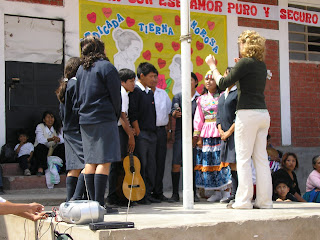 Neither was really in tune, but the microphone situation was not great either, so you couldn't really tell the difference in the end--and the kids really enjoyed it. One of the fourth graders, just before we went up to sing, said to me with a huge grin on his face, "Señorita, Señorita! Somos el coro nosotros!" (We're the choir!) . I said, yes, you are the fourth grade choir of Fe y Alegría 34! Are you proud of yourselves? and got a resounding ¡Sí! It was ridiculously cute. And I am so proud of them because they are learning to sing do, mi, and sol in tune! They don't have high do yet, but we're working on that.
So for all those reasons, a year suddenly seems like way too short a time to do the work we're doing. After December, who is going to keep the choirs going? Will the current 10th graders learn to write essays about the books they read if I leave? As unqualified as I sometimes feel to be doing those things, I can tell they are needed, and it's so exciting to be bringing something to the school that wasn't there before. And I find myself thinking, is it possible that I might want to stay another year? I had never entertained the thought until recently, but just knowing how long it takes to find one's niche, and thinking of new volunteers having to start over every year, and starting to feel part of the community a bit... one wonders. But then I call my mom and hear about everything going on with my own family in the US, and I want to be there too. So we'll see. Graduate school hovers on the horizon in my future, but I'm in no hurry to start that; for now I'm very happy to be here.
When I first came, a year felt like forever; now only seven more months seems way too short! All of a sudden Catherine and I are both really busy in the school and the parish. In addition to my English groups, Comunicación classes, and choirs (I'm working on getting two rehearsals per week with each), and Catherine's English groups, English classes, English clubs, and tutoring students in English, we are team-teaching a beginning English class for adults and adolescents in the parish on Tuesday-Thursday nights. It is a ton of fun because some of the students are our friends from the church choir, others bring their young children, and it is a relaxed but interested atmosphere (and they take notes without being told to copy the board! So amazing!). It's a tad frustrating when people waltz in 20 minutes late, however, and say Good Evening like nothing happened. We have scolded them to come on time, but it doesn't do much good. 20 minutes late is practically standard for some Peruvians, and as for parties, we've learned not to show up until an hour after it supposedly starts.Some changes in my work at the school that I am really excited about: I am now going to have my literature discussion with the Comunicación kids during their two-period class instead of their one-period class, so I get them for an hour and a half per week instead of 45 minutes! Maybe I will actually get some things discussed! Also, two of the best students in the class responded with real interest to my offer of private tutoring in how to write essays about the books we read. They are utterly bored in class and want to do more interesting things, and moreover, they will need to be able to write about what they read if they want to go to college. Angela, the one girl who always gets 100% on everything, has just been dying for something else to challenge her--I saw it first in her reading quizzes and then in the little sparkle in her eyes when I proposed that she come for lessons on how to write essays. I am so excited to get her and Karen on their own and get into some of the more interesting things going on in these books, and then get them writing about them!
Last Friday, my choirs sang for the first time during the performances for Mother's Day! Mother's Day is the biggest holiday I have experienced yet in Peru--all the stores go nuts with advertising, things close the Friday before and the Monday after, there are half-days at school and the mothers are invited to see the kids put on dance numbers in their honor.
The graduating class did an amazing traditional dance from the sierra. It looks almost like Valentine's Day with all the hearts and roses and cards and flowery poetry for Mamá spilling out of every store, not to mention the long speeches after church in praise of mothers and the raffles of pretty baskets filled with all sorts of foodstuffs for the house. (One of the speakers after church, a mother herself, even mentioned that the best thing to do for one's mother is to cook dinner once in a while and let her rest. But in general the ceremonies focus on how loving and giving mothers are and how children should always remember them and care for them... it's really very touching. Peruvians are very good at tenderness, at honoring love and devotion, especially in families.) Anyway, each of my choirs, the fourth graders and the 9th-11th graders, sang a song for their moms.Neither was really in tune, but the microphone situation was not great either, so you couldn't really tell the difference in the end--and the kids really enjoyed it. One of the fourth graders, just before we went up to sing, said to me with a huge grin on his face, "Señorita, Señorita! Somos el coro nosotros!" (We're the choir!) . I said, yes, you are the fourth grade choir of Fe y Alegría 34! Are you proud of yourselves? and got a resounding ¡Sí! It was ridiculously cute. And I am so proud of them because they are learning to sing do, mi, and sol in tune! They don't have high do yet, but we're working on that. So for all those reasons, a year suddenly seems like way too short a time to do the work we're doing. After December, who is going to keep the choirs going? Will the current 10th graders learn to write essays about the books they read if I leave? As unqualified as I sometimes feel to be doing those things, I can tell they are needed, and it's so exciting to be bringing something to the school that wasn't there before. And I find myself thinking, is it possible that I might want to stay another year? I had never entertained the thought until recently, but just knowing how long it takes to find one's niche, and thinking of new volunteers having to start over every year, and starting to feel part of the community a bit... one wonders. But then I call my mom and hear about everything going on with my own family in the US, and I want to be there too. So we'll see. Graduate school hovers on the horizon in my future, but I'm in no hurry to start that; for now I'm very happy to be here.
Tuesday, May 1, 2007
Randomness
This entry will continue to grow throughout the year; I will try to update it with some of the things I find funny, shocking, or more interesting than usual.
Llama sighting!! A few weeks ago we saw our first real live llama in the park in the pueblo. (It was very small and may actually have been a vicuña, but that's close enough.) It was decked out in brightly colored trappings and there was a little girl nearby in traditional highland dress--clearly something that did not belong there among the buses and commercial streets. It looked like someone had brought it there as an attraction for kids, and you could get your picture taken with it if you wanted. Unfortunately I didn't do this because I had to jump on a bus that was leaving.
Sheep walking. One day when I went out to jog around the cancha, there were several people out with their dogs and one guy out walking his sheep. I have also seen this sheep in its house, where it hangs out on the roof baaaaaing at passersby just like all the dogs do.
Enormous avocados. Last week I bought two that were each the size of a small eggplant. They were delicious.
Haircut for a dollar! "What the heck, it's a dollar" was my swing thought here. I had heard that haircuts were ridiculously cheap here in the pueblo, but still, at first I didn't believe I had heard the señora correctly when she said 3 soles. I showed her about how much I wanted cut off, and she proceeded to take large sections of my hair, dry, and go CHOP! Amazingly, it turned out pretty good.
Chicken farms. Possibly the most surreal moment of this whole year. Our friend Alfredo is a chicken farmer, and when he drove us to Huacho for the weekend, we stopped by his work so he could see to a few things. The chicken farms were in the middle of nowhere and the desert around looked like rainbow sherbet because of all the vividly different colors of the sand, it was very starkly beautiful. We couldn't go in because chickens are apparently really susceptible to disease, so Catherine and I stayed in the car reading our books, except at one point when we got out and wandered down the road out of boredom, and a car of Peruvians came driving by and stared at us as if to say that a pair of gringas out for a stroll around the chicken farms was the most surreal moment of their year as well.
Trash truck. People don't leave their trash out all night here for the truck to collect in the morning, because the dogs wandering loose around the street would get it. So the trash truck comes by once every few days and just parks on the corner for a few minutes to announce its presence. It honks its horn imperiously, without stopping, and one of the workers hops down and rings the heck out of something that looks like a huge, clanging triangle. Then it goes slowly on down the street while people come running out of their houses with their trash to catch it.
Ketchup in a bag... and milk, and jelly, and mayonnaise, and other things you would normally find in cans or cartons in the US, they are all sold in plastic bags around here. Cheaper, but more difficult to re-seal.
Listening to "Whip it" on the taxi ride back from Ollantaytambo to Cusco, at night under a gorgeous full moon. We asked for American music...
No seatbelts necessary. Peruvian men ride motor vehicles in all the ways you always wanted to as a kid, but your parents wouldn't let you. Lounging in the back of pickup trucks, in the trunk of the taxi, perched on top of the cargo cases on a multi-axel delivery truck. On the way back from Arequipa to Lima, the bus stopped for breakfast and one of the drivers opened an underneath baggage compartment--and the other driver climbs out. He had a little bed and pillow made up in there for himself.
Two-in-one banana! Picture coming soon.
My sandals molded. I should have known better than to keep them in a drawer in Lima for months during winter. Good thing they were old.
Llama sighting!! A few weeks ago we saw our first real live llama in the park in the pueblo. (It was very small and may actually have been a vicuña, but that's close enough.) It was decked out in brightly colored trappings and there was a little girl nearby in traditional highland dress--clearly something that did not belong there among the buses and commercial streets. It looked like someone had brought it there as an attraction for kids, and you could get your picture taken with it if you wanted. Unfortunately I didn't do this because I had to jump on a bus that was leaving.
Sheep walking. One day when I went out to jog around the cancha, there were several people out with their dogs and one guy out walking his sheep. I have also seen this sheep in its house, where it hangs out on the roof baaaaaing at passersby just like all the dogs do.
Enormous avocados. Last week I bought two that were each the size of a small eggplant. They were delicious.
Haircut for a dollar! "What the heck, it's a dollar" was my swing thought here. I had heard that haircuts were ridiculously cheap here in the pueblo, but still, at first I didn't believe I had heard the señora correctly when she said 3 soles. I showed her about how much I wanted cut off, and she proceeded to take large sections of my hair, dry, and go CHOP! Amazingly, it turned out pretty good.
Chicken farms. Possibly the most surreal moment of this whole year. Our friend Alfredo is a chicken farmer, and when he drove us to Huacho for the weekend, we stopped by his work so he could see to a few things. The chicken farms were in the middle of nowhere and the desert around looked like rainbow sherbet because of all the vividly different colors of the sand, it was very starkly beautiful. We couldn't go in because chickens are apparently really susceptible to disease, so Catherine and I stayed in the car reading our books, except at one point when we got out and wandered down the road out of boredom, and a car of Peruvians came driving by and stared at us as if to say that a pair of gringas out for a stroll around the chicken farms was the most surreal moment of their year as well.
Trash truck. People don't leave their trash out all night here for the truck to collect in the morning, because the dogs wandering loose around the street would get it. So the trash truck comes by once every few days and just parks on the corner for a few minutes to announce its presence. It honks its horn imperiously, without stopping, and one of the workers hops down and rings the heck out of something that looks like a huge, clanging triangle. Then it goes slowly on down the street while people come running out of their houses with their trash to catch it.
Ketchup in a bag... and milk, and jelly, and mayonnaise, and other things you would normally find in cans or cartons in the US, they are all sold in plastic bags around here. Cheaper, but more difficult to re-seal.
Listening to "Whip it" on the taxi ride back from Ollantaytambo to Cusco, at night under a gorgeous full moon. We asked for American music...
No seatbelts necessary. Peruvian men ride motor vehicles in all the ways you always wanted to as a kid, but your parents wouldn't let you. Lounging in the back of pickup trucks, in the trunk of the taxi, perched on top of the cargo cases on a multi-axel delivery truck. On the way back from Arequipa to Lima, the bus stopped for breakfast and one of the drivers opened an underneath baggage compartment--and the other driver climbs out. He had a little bed and pillow made up in there for himself.
Two-in-one banana! Picture coming soon.
My sandals molded. I should have known better than to keep them in a drawer in Lima for months during winter. Good thing they were old.
Tuesday, April 24, 2007
Classes advance
The weather is moving toward autumn here: Sunday morning was damply chilly and completely cloudy, so that the nearby mountains and the ocean were both invisible from the roof. (I love hanging my laundry out on the roof because whenever I go up there, the view of all the brick houses and dusty roads up and down the hill makes me stop and ponder the fact that I'm in Peru, on a roof, hanging my hand-washed laundry out to dry.) From what I've heard, the entire winter in Lima is cloudy, chilly, and damp... something to look foreward too. On the plus side, I really have gotten used to cool or lukewarm showers--it actually feels weird to me now to take a steamy hot shower or to leave the water running the entire time. I tried it recently when we went away for the weekend and stayed in a hostel, and it just wasn't as great as I remembered. It helps that I'm getting up early to go jogging almost every other morning, so I'm all warmed up by the time I shower. Other things I am surprisingly used to are lighting the gas stove and oven with a match, flushing the toilet with buckets of water left over from doing laundry, and washing all the dishes by hand. I only very rarely miss driving; I miss my washer and dryer constantly. It's even stranger to be without things like a microwave, dishwasher, etc. now that we have recently gotten high-speed Internet in the house. (YAY!!)
We've now had almost two full months of classes at Fe y Alegría, and our schedules are finally settling down into what we hope will be a comfortable pattern for the year. A brief description of what I do on a weekly basis:
I am working with small groups of 9th and 10th grade students during their English class, taking them to the library to work on conversation and grammar a bit more extensively than they would do in the classroom. It is nice to work with only six students at a time, but Catherine and I have both felt frustrated lately because there is little continuity in teaching this way: the groups keep changing, which on one hand gives everybody a chance to work with us, but on the other hand means that you can never be sure what you have taught to whom, or establish any standards for your little "class" such as speaking English whenever possible. Apart from English groups, I am also helping two of the 11th grade Communication classes (what we would call an English class) with discussion of literature. Every Friday, half of each class goes with me to discuss the book they're reading in the auditorium, while the other group stays with the teacher to discuss their book. I've been giving reading quizzes and working with them on pulling quotes out of the text to answer the questions I ask. It's extremely difficult to make them do the reading they're supposed to do outside of class. The students are all incredibly warm, energetic, and eager to learn, but they haven't been taught to do much of anything on their own; from what I've seen, the classes seem to emphasize memorization over critical thinking. The first few reading quizzes have been abysmal, and on their test, which covered both my book and other things they're doing with their teacher, some of them simply don't answer whole sections. It's a little scary. Last Friday I think I finally scared some of them by handing back the reading quizzes, but I honestly don't know what I'm going to do if they don't respond to my attempts to get them to read. I don't want to be the bad guy yelling at them all year, but there's so little class time that I barely have time to do anything else.
For the first few months I was here, there was almost no music in my life, which I felt as a loss--but recently I have become very musically occupied once again! Last Friday was my first rehearsal with a chorus of nineteen fourth-graders, and it went very well. I call them my Pollitos, or Little Chickens, because their "audition" was to sing a children's song about little chickens in two different keys, and the ones who could more or less stay on pitch got to be in the choir. (There were surprisingly few who could.) They were very attentive for most of the rehearsal and completely unembarassed to use their voices in silly ways for warm-ups. We worked on singing the Spanish version of Frére Jaque, and I actually noticed an improvement in their intonation by the end of the rehearsal! I was so happy! I'm also working with a chorus of 9th through 11th graders, who are more hesitant about using their voices but able to sing more complicated things; so far we've managed to get four parts going on a simple song, badly tuned, but four parts nonetheless. The students love it. Several of the guys play guitar very well and accompany us. And finally, I've become a regular member of the church choir, which is fun because I get to meet adults from the parish.
In trying to find the best work for myself here, I've learned more about what my own vaguely-defined expectations were for this year and what I'd hoped to accomplish. I've discovered that being "The Teacher" is not a role I easily identify with--I don't have the training, the wardrobe, or the urge to impose my will on large groups of unruly young people, which seem necessary for the job. The way I see it, if you don't want to learn, it's your loss, so why should I drive myself crazy trying to force you? (Especially when I'm not trained to do so and don't really know what I'm doing?) I am well aware that this attitude makes me better suited for a college environment than a grade school one, and also that I have voluntarily come to Peru in order to help grade school students, so to some extent (as Catherine has pointed out) I did "sign up" to be The Teacher for a year. But if I stop to think about it, I realize that I never pictured myself in front of a class; my idea of "helping the school" was basically that of tutoring students one on one (including the adults whose classes have moved!) . Today, for example, I had a student come by for help with an English project, and I loved being able to work with just her, going through everything until she understood it. It's funny how you can get so caught up in what you think you're expected to be doing, and trying to make it work, that you forget that you might be better off doing what you're more comfortable with. For example, another thing I'd pictured myself doing was helping in the parish, visiting sick people or something like that, which I hadn't even thought to ask about until recently because I've been so focused on making things work at the school.
However, all that said, I definitely do enjoy working with my choirs, and even with the Communication class I am willing to play Teacher for the sake of having them read and talk about books, because music and literature are very important to me, and I'm confident in my ability to teach the students something in those areas. The English groups have drawn me into the school by introducing me to practically all the 8th through 11th grade students, but they are actually where I feel the least comfortable at this point, because I don't have the training that Catherine does in teaching languages. My next step is to reach out a little more to the parish and see if anything appealing needs doing there.
We've now had almost two full months of classes at Fe y Alegría, and our schedules are finally settling down into what we hope will be a comfortable pattern for the year. A brief description of what I do on a weekly basis:
I am working with small groups of 9th and 10th grade students during their English class, taking them to the library to work on conversation and grammar a bit more extensively than they would do in the classroom. It is nice to work with only six students at a time, but Catherine and I have both felt frustrated lately because there is little continuity in teaching this way: the groups keep changing, which on one hand gives everybody a chance to work with us, but on the other hand means that you can never be sure what you have taught to whom, or establish any standards for your little "class" such as speaking English whenever possible. Apart from English groups, I am also helping two of the 11th grade Communication classes (what we would call an English class) with discussion of literature. Every Friday, half of each class goes with me to discuss the book they're reading in the auditorium, while the other group stays with the teacher to discuss their book. I've been giving reading quizzes and working with them on pulling quotes out of the text to answer the questions I ask. It's extremely difficult to make them do the reading they're supposed to do outside of class. The students are all incredibly warm, energetic, and eager to learn, but they haven't been taught to do much of anything on their own; from what I've seen, the classes seem to emphasize memorization over critical thinking. The first few reading quizzes have been abysmal, and on their test, which covered both my book and other things they're doing with their teacher, some of them simply don't answer whole sections. It's a little scary. Last Friday I think I finally scared some of them by handing back the reading quizzes, but I honestly don't know what I'm going to do if they don't respond to my attempts to get them to read. I don't want to be the bad guy yelling at them all year, but there's so little class time that I barely have time to do anything else.
For the first few months I was here, there was almost no music in my life, which I felt as a loss--but recently I have become very musically occupied once again! Last Friday was my first rehearsal with a chorus of nineteen fourth-graders, and it went very well. I call them my Pollitos, or Little Chickens, because their "audition" was to sing a children's song about little chickens in two different keys, and the ones who could more or less stay on pitch got to be in the choir. (There were surprisingly few who could.) They were very attentive for most of the rehearsal and completely unembarassed to use their voices in silly ways for warm-ups. We worked on singing the Spanish version of Frére Jaque, and I actually noticed an improvement in their intonation by the end of the rehearsal! I was so happy! I'm also working with a chorus of 9th through 11th graders, who are more hesitant about using their voices but able to sing more complicated things; so far we've managed to get four parts going on a simple song, badly tuned, but four parts nonetheless. The students love it. Several of the guys play guitar very well and accompany us. And finally, I've become a regular member of the church choir, which is fun because I get to meet adults from the parish.
In trying to find the best work for myself here, I've learned more about what my own vaguely-defined expectations were for this year and what I'd hoped to accomplish. I've discovered that being "The Teacher" is not a role I easily identify with--I don't have the training, the wardrobe, or the urge to impose my will on large groups of unruly young people, which seem necessary for the job. The way I see it, if you don't want to learn, it's your loss, so why should I drive myself crazy trying to force you? (Especially when I'm not trained to do so and don't really know what I'm doing?) I am well aware that this attitude makes me better suited for a college environment than a grade school one, and also that I have voluntarily come to Peru in order to help grade school students, so to some extent (as Catherine has pointed out) I did "sign up" to be The Teacher for a year. But if I stop to think about it, I realize that I never pictured myself in front of a class; my idea of "helping the school" was basically that of tutoring students one on one (including the adults whose classes have moved!) . Today, for example, I had a student come by for help with an English project, and I loved being able to work with just her, going through everything until she understood it. It's funny how you can get so caught up in what you think you're expected to be doing, and trying to make it work, that you forget that you might be better off doing what you're more comfortable with. For example, another thing I'd pictured myself doing was helping in the parish, visiting sick people or something like that, which I hadn't even thought to ask about until recently because I've been so focused on making things work at the school.
However, all that said, I definitely do enjoy working with my choirs, and even with the Communication class I am willing to play Teacher for the sake of having them read and talk about books, because music and literature are very important to me, and I'm confident in my ability to teach the students something in those areas. The English groups have drawn me into the school by introducing me to practically all the 8th through 11th grade students, but they are actually where I feel the least comfortable at this point, because I don't have the training that Catherine does in teaching languages. My next step is to reach out a little more to the parish and see if anything appealing needs doing there.
Friday, April 13, 2007
Holy Week and the choir
Just after I wrote my frustrated rant about not being part of this community, things began to change in that respect. Since I have never been one to walk up to random people on the street and make friends with them, I started asking all the sisters for ideas on how to meet people. We agreed that the church choir would be a good option. Then, a few days afterwards, Sister Denise brought us to visit a friend of hers, Elisabeth, who teaches at our school. We spent a lovely two hours at Elisabeth's house with her, her husband, her father, and her one-year-old baby. Peruvians are all extremely warm, gracious hosts; Elisabeth served us Coke and crackers and we talked about the school, Peru, the US, travel, etc. They were such a cheerful family and they invited us back any time. It was nice just to feel invited somewhere! Also, I found out that at least the older and more "finished" houses around here do have running water, electricity, a TV (but no air conditioning or heat, like most of the country).
The same week, I finally got connected with the church choir. Catherine and I had planned to go to Ica for Holy Thursday and Good Friday, but the friend who was going to be our ride called two days beforehand to cancel, and so we were left disappointed. Catherine took another trip back to visit Tony's house in Chaclacayo for a day and a half, but I stayed around because I wanted to see how Holy Week is celebrated here in Delicias... and it turned out to be a great thing that I hadn't left. On Good Friday there was a Via Crucis ceremony in which the fourteen Stations of the Cross were represented by fourteen people in the neighborhood who are ill. The procession left the church and walked around singing to all of the fourteen houses, and at each one there was a prayer and a song with the sick person and their family coming to the door of the house. It was really touching to visit these people, mostly elderly women, and to see the face of God reflected in them and their suffering. It was also a three-hour-long opportunity for me to meet the leaders of the choir. I asked if I could join, and the next day I found myself in rehearsal for the Easter Sunday Mass. It was the most fun I have ever had in a choir that can't sing in tune to save their lives! (The director is talented, and did a beautiful solo song with his guitar for the meditation at Easter, but the group as a whole has major issues. If you think this is just my musical elitism talking, Catherine will tell you how painful it can be in Mass sometimes.) Everybody was really warm and welcoming, asking me where I was from, what I was doing there, etc, and inviting me to sing with them at the Wednesday and Sunday Masses. I was thrilled to have another thing to do, plus a way to meet people and use my interest in music. Teresa had told me earlier that I could be of help to the choir, and I was a little hesitant to go in and try to teach them things "my way," but I never understood what a gift I can bring to them just by singing and playing in tune. I'm planning to teach them one of my favorite church songs that I've found a Spanish translation to in the sisters' song book.
The Easter celebration here was one of the coolest things I have seen yet. It combines a nighttime vigil with a Sunday morning Mass. We started at four o'clock in the morning on the big soccer field across the street from our house. The priests and the altar were in the middle of the field, and the people stood all around on the concrete stadium steps, each person with a candle. There was a huge bonfire, out of which the priest lit the Easter candle, and the youth group did a great dance around it to Andean pipe and guitar music; somebody had made a very precarious-looking tower out of sticks and mounted fireworks on it, which went off one after the other in white spirals that spun and then went out and little rockets that didn't go very high--the technology was "más o menos," like that of the microphone and amplification system, but the people loved it. From the Easter candle, the priest passed the light to the people, and in the dark as we waited for the Resurrection and the sunrise, the whole stadium was lit up with little hopeful golden candles. By the time the Mass ended, the sun was up and it was Easter morning! Afterwards, the other house of sisters came over to our place, and Catherine and I cooked everyone an American pancake breakfast... the only bad part was that we were too full later when we went over to their house for a Peruvian lunch of ceviche, chicken and rice, and fruit salad. It was a great day and a great weekend.
The same week, I finally got connected with the church choir. Catherine and I had planned to go to Ica for Holy Thursday and Good Friday, but the friend who was going to be our ride called two days beforehand to cancel, and so we were left disappointed. Catherine took another trip back to visit Tony's house in Chaclacayo for a day and a half, but I stayed around because I wanted to see how Holy Week is celebrated here in Delicias... and it turned out to be a great thing that I hadn't left. On Good Friday there was a Via Crucis ceremony in which the fourteen Stations of the Cross were represented by fourteen people in the neighborhood who are ill. The procession left the church and walked around singing to all of the fourteen houses, and at each one there was a prayer and a song with the sick person and their family coming to the door of the house. It was really touching to visit these people, mostly elderly women, and to see the face of God reflected in them and their suffering. It was also a three-hour-long opportunity for me to meet the leaders of the choir. I asked if I could join, and the next day I found myself in rehearsal for the Easter Sunday Mass. It was the most fun I have ever had in a choir that can't sing in tune to save their lives! (The director is talented, and did a beautiful solo song with his guitar for the meditation at Easter, but the group as a whole has major issues. If you think this is just my musical elitism talking, Catherine will tell you how painful it can be in Mass sometimes.) Everybody was really warm and welcoming, asking me where I was from, what I was doing there, etc, and inviting me to sing with them at the Wednesday and Sunday Masses. I was thrilled to have another thing to do, plus a way to meet people and use my interest in music. Teresa had told me earlier that I could be of help to the choir, and I was a little hesitant to go in and try to teach them things "my way," but I never understood what a gift I can bring to them just by singing and playing in tune. I'm planning to teach them one of my favorite church songs that I've found a Spanish translation to in the sisters' song book.
The Easter celebration here was one of the coolest things I have seen yet. It combines a nighttime vigil with a Sunday morning Mass. We started at four o'clock in the morning on the big soccer field across the street from our house. The priests and the altar were in the middle of the field, and the people stood all around on the concrete stadium steps, each person with a candle. There was a huge bonfire, out of which the priest lit the Easter candle, and the youth group did a great dance around it to Andean pipe and guitar music; somebody had made a very precarious-looking tower out of sticks and mounted fireworks on it, which went off one after the other in white spirals that spun and then went out and little rockets that didn't go very high--the technology was "más o menos," like that of the microphone and amplification system, but the people loved it. From the Easter candle, the priest passed the light to the people, and in the dark as we waited for the Resurrection and the sunrise, the whole stadium was lit up with little hopeful golden candles. By the time the Mass ended, the sun was up and it was Easter morning! Afterwards, the other house of sisters came over to our place, and Catherine and I cooked everyone an American pancake breakfast... the only bad part was that we were too full later when we went over to their house for a Peruvian lunch of ceviche, chicken and rice, and fruit salad. It was a great day and a great weekend.
Tuesday, April 3, 2007
A day off
A week ago last Monday, there was no school for a teacher meeting, so Sister Teresa took me and Catherine to get our resident ID cards from the immigration office in Lima. We are now legal residents of Peru until March 2008. It was cool to see all the different kinds of people in the immigration office--some gringos like us, some Asian people, and some Peruvians there for their own passports and such. We took a colectivo, which is like a taxi car with a set route, into the center of the city because it was faster than a bus... and the driver was determined to get us there fast, because I counted no less than four lights which turned red just before he continued through them, and even in Peru I've never seen anybody inch between two lanes of traffic quite so daringly. Then he charged Teresa 3 soles for each of us, and when she asked when the price had gone up from 2.50 to 3, he handed her the extra 1.50 back immediately, very matter-of-factly, with no effort at argument and no air of shame for having tried to pull a fast one on the three white people. Ah, Peru.
After the immigration office, Teresa had other errands to run, so me and Catherine had a great lunch in this little corner restaurant of the type so typical here. There's a Menu of the Day written on a dry-erase board out front; you get to choose either a soup or an appetizer, and then you choose your main course from two to five options, and both courses plus a drink costs 5 soles, less than $2. These little places seem sketchy from the outside because they're so unofficial-looking, but the food is excellent! I had chicken with pinapple sauce, rice, and beans, and Catherine had goat (yes, goat) with cilantro sauce. My appetizer was avocado salad and hers was a chicken tamale. Mmmm, delicious.
After lunch we wanted to go to Metro, the supermarket that looks like any American Giant or Safeway, for some things we don't buy in the market in the pueblo. But right next to Metro is Ripley, the Peruvian version of Sears or Hecht's, and we had an urge to go shopping. I hadn't realized until we walked in how much I had been longing for something "normal," that is, similar to the world I knew for the first twenty-two-plus years of my life. We spent hours looking for sales, trying things on, and at the end I bought a sweater and jeans... I have never been so happy to be in a department store. Metro had the same effect--it was amazing to be shopping with a shopping cart, aisles, things in cans, Corn Flakes on the shelves, etc. I bought macaroni and cheese in a box as a special treat (the cheese was too expensive for us to buy enough of it to make our own macaroni, which was the original plan.) It's amazing the things that one misses being away--all the stupid little foods that are so common in America, like macaroni and cheese, and aren't even that great except that they're what you're used to. Bubble tea, Domino's pizza, the Bagel Bin in Ellicott City, and Shanghai Cafe are other cravings I've had. But what can you do... the ceviche with sweet potato or the sandwiches with avocado and lime are here to make up for it.
After the immigration office, Teresa had other errands to run, so me and Catherine had a great lunch in this little corner restaurant of the type so typical here. There's a Menu of the Day written on a dry-erase board out front; you get to choose either a soup or an appetizer, and then you choose your main course from two to five options, and both courses plus a drink costs 5 soles, less than $2. These little places seem sketchy from the outside because they're so unofficial-looking, but the food is excellent! I had chicken with pinapple sauce, rice, and beans, and Catherine had goat (yes, goat) with cilantro sauce. My appetizer was avocado salad and hers was a chicken tamale. Mmmm, delicious.
After lunch we wanted to go to Metro, the supermarket that looks like any American Giant or Safeway, for some things we don't buy in the market in the pueblo. But right next to Metro is Ripley, the Peruvian version of Sears or Hecht's, and we had an urge to go shopping. I hadn't realized until we walked in how much I had been longing for something "normal," that is, similar to the world I knew for the first twenty-two-plus years of my life. We spent hours looking for sales, trying things on, and at the end I bought a sweater and jeans... I have never been so happy to be in a department store. Metro had the same effect--it was amazing to be shopping with a shopping cart, aisles, things in cans, Corn Flakes on the shelves, etc. I bought macaroni and cheese in a box as a special treat (the cheese was too expensive for us to buy enough of it to make our own macaroni, which was the original plan.) It's amazing the things that one misses being away--all the stupid little foods that are so common in America, like macaroni and cheese, and aren't even that great except that they're what you're used to. Bubble tea, Domino's pizza, the Bagel Bin in Ellicott City, and Shanghai Cafe are other cravings I've had. But what can you do... the ceviche with sweet potato or the sandwiches with avocado and lime are here to make up for it.
Quarter-year reflections
Wow, we have been here for three months now... one-quarter of our volunteer time!
Three months seems to bring with it a kind of second-wave culture shock, what you might call an end to the "honeymoon period" of being in a foreign country. At first, everything here was so new and different that even the weird, uncomfortable, or annoying things about Peru were all part of the adventure. Now, however, the house we're living in feels like "my house," the street is "my street," the view out the front window of the guys playing soccer on the field opposite the house has become very familiar. Even the market is becoming an expected sight (only the occasional shocker, like the live frogs I saw being sold the other day, still hits me strongly) and the crazy Peruvian driving has ceased to terrify me at all. But as I begin to regard parts of this life as "normal" and thus expect less of the unexpected, things that didn't bother me before have really started to shock and irritate me. If this is "my house" and "my neighborhood," why do I still get whistled at and stared at every time I step out the door? It seems like I can't walk down the street without passing a group of men and hearing wolf whistles or badly pronounced "Hello"s or just plain "Muy bonita!" ("very pretty!") called out after me. It's something that seems completely normal to the people here, men and women alike, but as an American, I can't stop finding it rude and offensive--and more than anything, it makes both me and Catherine feel our status as outsiders very intensely. We're not the tourists here anymore, we're the tourist attraction, and more than anything I would like to figure out how to become more a part of this community.
The community is too large to meet everyone. Mostly we are friends with the sisters we live with, the other house of nuns down the street, and a group of young Peruvians we met through Dr. Tony's house in Chaclacayo. We have been out dancing with them twice and had a good time--my favorite part was seeing two amazing live salsa bands at the club we went to. But in the neighborhood where we live, we simply don't have friends. We know the people at Fe y Alegría, somewhat; at least, everyone is very warm and kind in greeting us when we walk around the school. The students all call out "Miss! Miss!" or "Señorita! Hola!" when they see you, and lots of them come up to give you a kiss on the cheek, which is how people greet each other in Lima. But students aren't friends, and most of the teachers are married with their own families and lives to attend to... and at the end of the day, most of the people we pass on the street don't know us. Last Sunday my frustration about this boiled over, and we spent a long time talking to the sisters about possible ways for us to meet people. Sister Denise has come up with a few contacts for us, so we'll see how that goes. But we discovered in our discussion that the problem may be that the young women around here simply aren't visible. They either have jobs, go to school and have jobs, or are mothers in their early twenties and spend their time with their families. They seem to live their lives in a more private sphere... at least, that would explain why we constantly see groups of men hanging out on the streets, but never a group of young women.
Anyway, our introduction period is over, we're back from our summer at Tony's and our "real work" is solidly underway... and the question appears, are we doing what we came here to do? Is it worth the enormous effort and all the donations that went into NDMVP's program to bring us here? Are we being of service to this community? So far, in the middle of much chaos as I try to find my niche at the school, one thing is working pretty well: I do feel that my English groups are contributing to those students' learning. Not only are they learning some more English, but I have also been working on some study habits with them. Peruvian students (at least these ones) are very warm, eager, energetic, and interested to learn--a far cry from American high schoolers with their "too cool for school" attitudes--but they have absolutely no study habits, no idea how to learn independently, because they haven't been taught to think critically. The idea of taking notes is foreign to them. If you tell them to copy the board, they all copy beautifully, in two different pen colors and a highlighter, but until you tell them to, they just sit there, not even taking out their notebooks. The other day I said to my Comunicación section, "Take out your notebooks," and one girl asked me in perfect seriousness, "Pens too?" I have been trying to tell them that their notebooks are their own, and if they want to remember something later, they should write down the most important things we talk about in class so they can study it. Some of my English students were actually taking notes on their own the other day and I got so happy!One of the jobs I had hoped to do here, however, has disappeared--the Saturday radio school for adults to get the equivalent of their GED has been moved to another location, and so I can't help with that. I had really looked forward to teaching adults basic reading or math, but even if I were to take on students for tutoring, they couldn't get their certification just from me, they'd have to go to the school in its new location, which is two bus rides away. So that's no longer an option.
Now that we're settling in a little bit, the next step is to really become part of the community, to start actually "living here" instead of just being here on a long vacation. It's not just something I want, or something that would be good for cultural exchange, it's something I need very badly in order not to feel like an exile for my entire year here. I'm still planning to join the church choir here to meet some people and get some singing back in my life. As soon as I get back from our trip to Ica this weekend, I'll go up and introduce myself to them after Mass and ask if I can sing. And we'll see where things go from there. Ideally, it would lead to my meeting a few families, some neighbors perhaps, and getting to know some adults instead of just the kids in the school.
The most overwhelming impression I have after a quarter of a year here is that I am now familiar with a different reality. It's kind of incredible to me that four months ago, I had almost no idea of any different kind of life that the one I had lived for 22 years in the United States--and now the sights and sounds of Peru, the crazy crazy buses, the salsa and reggaeton on the radio, the desert, the colors, the market, the mountains, the people, are all starting to sink into my mind as a coherent world, something that I recognize and maybe even understand a bit. Spanish is coming more and more easily every month. Black hair, almond-brown skin, and deep beautiful brown eyes are now the norm that my brain expects when looking at people, and I realize just how much I stand out when I see another white person and find myself staring at them exactly the way I hate to be stared at by Peruvians. I guess the eye is naturally drawn to whatever is different... anyway, it's starting to feel like I'm here to stay for a while.
Three months seems to bring with it a kind of second-wave culture shock, what you might call an end to the "honeymoon period" of being in a foreign country. At first, everything here was so new and different that even the weird, uncomfortable, or annoying things about Peru were all part of the adventure. Now, however, the house we're living in feels like "my house," the street is "my street," the view out the front window of the guys playing soccer on the field opposite the house has become very familiar. Even the market is becoming an expected sight (only the occasional shocker, like the live frogs I saw being sold the other day, still hits me strongly) and the crazy Peruvian driving has ceased to terrify me at all. But as I begin to regard parts of this life as "normal" and thus expect less of the unexpected, things that didn't bother me before have really started to shock and irritate me. If this is "my house" and "my neighborhood," why do I still get whistled at and stared at every time I step out the door? It seems like I can't walk down the street without passing a group of men and hearing wolf whistles or badly pronounced "Hello"s or just plain "Muy bonita!" ("very pretty!") called out after me. It's something that seems completely normal to the people here, men and women alike, but as an American, I can't stop finding it rude and offensive--and more than anything, it makes both me and Catherine feel our status as outsiders very intensely. We're not the tourists here anymore, we're the tourist attraction, and more than anything I would like to figure out how to become more a part of this community.
The community is too large to meet everyone. Mostly we are friends with the sisters we live with, the other house of nuns down the street, and a group of young Peruvians we met through Dr. Tony's house in Chaclacayo. We have been out dancing with them twice and had a good time--my favorite part was seeing two amazing live salsa bands at the club we went to. But in the neighborhood where we live, we simply don't have friends. We know the people at Fe y Alegría, somewhat; at least, everyone is very warm and kind in greeting us when we walk around the school. The students all call out "Miss! Miss!" or "Señorita! Hola!" when they see you, and lots of them come up to give you a kiss on the cheek, which is how people greet each other in Lima. But students aren't friends, and most of the teachers are married with their own families and lives to attend to... and at the end of the day, most of the people we pass on the street don't know us. Last Sunday my frustration about this boiled over, and we spent a long time talking to the sisters about possible ways for us to meet people. Sister Denise has come up with a few contacts for us, so we'll see how that goes. But we discovered in our discussion that the problem may be that the young women around here simply aren't visible. They either have jobs, go to school and have jobs, or are mothers in their early twenties and spend their time with their families. They seem to live their lives in a more private sphere... at least, that would explain why we constantly see groups of men hanging out on the streets, but never a group of young women.
Anyway, our introduction period is over, we're back from our summer at Tony's and our "real work" is solidly underway... and the question appears, are we doing what we came here to do? Is it worth the enormous effort and all the donations that went into NDMVP's program to bring us here? Are we being of service to this community? So far, in the middle of much chaos as I try to find my niche at the school, one thing is working pretty well: I do feel that my English groups are contributing to those students' learning. Not only are they learning some more English, but I have also been working on some study habits with them. Peruvian students (at least these ones) are very warm, eager, energetic, and interested to learn--a far cry from American high schoolers with their "too cool for school" attitudes--but they have absolutely no study habits, no idea how to learn independently, because they haven't been taught to think critically. The idea of taking notes is foreign to them. If you tell them to copy the board, they all copy beautifully, in two different pen colors and a highlighter, but until you tell them to, they just sit there, not even taking out their notebooks. The other day I said to my Comunicación section, "Take out your notebooks," and one girl asked me in perfect seriousness, "Pens too?" I have been trying to tell them that their notebooks are their own, and if they want to remember something later, they should write down the most important things we talk about in class so they can study it. Some of my English students were actually taking notes on their own the other day and I got so happy!One of the jobs I had hoped to do here, however, has disappeared--the Saturday radio school for adults to get the equivalent of their GED has been moved to another location, and so I can't help with that. I had really looked forward to teaching adults basic reading or math, but even if I were to take on students for tutoring, they couldn't get their certification just from me, they'd have to go to the school in its new location, which is two bus rides away. So that's no longer an option.
Now that we're settling in a little bit, the next step is to really become part of the community, to start actually "living here" instead of just being here on a long vacation. It's not just something I want, or something that would be good for cultural exchange, it's something I need very badly in order not to feel like an exile for my entire year here. I'm still planning to join the church choir here to meet some people and get some singing back in my life. As soon as I get back from our trip to Ica this weekend, I'll go up and introduce myself to them after Mass and ask if I can sing. And we'll see where things go from there. Ideally, it would lead to my meeting a few families, some neighbors perhaps, and getting to know some adults instead of just the kids in the school.
The most overwhelming impression I have after a quarter of a year here is that I am now familiar with a different reality. It's kind of incredible to me that four months ago, I had almost no idea of any different kind of life that the one I had lived for 22 years in the United States--and now the sights and sounds of Peru, the crazy crazy buses, the salsa and reggaeton on the radio, the desert, the colors, the market, the mountains, the people, are all starting to sink into my mind as a coherent world, something that I recognize and maybe even understand a bit. Spanish is coming more and more easily every month. Black hair, almond-brown skin, and deep beautiful brown eyes are now the norm that my brain expects when looking at people, and I realize just how much I stand out when I see another white person and find myself staring at them exactly the way I hate to be stared at by Peruvians. I guess the eye is naturally drawn to whatever is different... anyway, it's starting to feel like I'm here to stay for a while.
Subscribe to:
Posts (Atom)


