Sunday, September 23, 2007

Tambogrande again

(The bridge from Tambogrande to the outlying caserio of Locutos. The bridge is made of sticks and packed dirt and they build it from scratch every year when the river goes down. When the river is high, in the summer, it sweeps the bridge away and the people cross over in rafts made of inflated tires and pulled by somebody swimming. At least this is what they tell me.)


I'm in Tambogrande once more. It's sunny and warm and beautiful!!! That 14-hour overnight bus ride seems like it took me from Lima winter to Bethany Beach in the summer, except less humid, more breezy, and deliciously cool at night. "Winter" in Tambogrande means you sleep with a light blanket, go around in your jeans and t-shirt in the morning and evening, and lie around doing nothing from 2 to 4 pm because it gets HOT. The last time I came here, in March, it was the end of summer and the HOT was all the time, barely even cooling off enough at night to let you sleep. It's not humid like it is in Maryland, but I'm sure it passes 100 degrees Farenheit every day (right now it might get up to 80 or 90), and you just feel like you're baking in a still hot oven.


The locals talk proudly about how those who aren't used to the calor fuerte of the North usually can't take it. They build their houses with high roofs, make them of brick or bamboo instead of wood, and some of the more rural ones don't even have doors and windows that close, just openings in the walls... and even the walls aren't all there; most houses have a few rooms in front and then a back room that opens straight out under a woven-bamboo roof onto a garden, with flowers, trees, chickens, etc. The gardens are not at all neat but profusely alive. This helps me understand a little why so many Peruvians who move to Lima and build houses in the pueblos jovenes don't put back walls on them. The house is not meant to seal you off from the outdoors. (What a concept!... and it works great here... just not in Lima.) In the heat I also see why the women, no matter what their age or what they look like, are much more comfortable than North American women with wearing stretchy skirts and midriff-baring tanks. It's less formal and more comfortable here in the rural North of Peru.

On Sunday we all went to Sister Marleney's final vows, a beautiful, happy celebration at a Mass in the countryside where Marleney teaches in a Fe y Alegría school. The school was in the middle of nowhere down these dirt roads that wind through a half-desert landscape. There are trees and the occasional stream and sometimes whole fields of vibrantly green rice plants, but the ground is sandy and dry. The Mass was under a white pavilion run with green ribbons and decorated with tons of sunflowers, the symbol of the Sisters of Notre Dame de Namur. It was hot.

Before Marleney professed her vows, the priest gave her the microphone and asked her to talk to everyone about how she got to be here. Her testimony was really moving. She talked about the "human ties" that led her from one step to another in her journey toward becoming a Sister of Notre Dame; she said she didn't want to even hear about religious life at first, but little by little, sometimes fighting with God, she discovered that "this is my happiness." The priest asked her if she'd ever been in love and to talk about what love means to her. She said yes, of course; she's a woman, a complete person, and yes she had had a boyfriend years ago, and she is happy now that he is married with kids while she has found her happiness here. "Love, to me, is to give yourself completely and be left with nothing, but at the same time to receive everything. I know that for the rest of my life I will be thirsting for this God, and I am here to give myself over to Him completely, not 'until death do us part' but until death unites us."

I was sitting in the front row with the rest of the sisters and I'm sure everyone there thought I was a nun too. It was kind of awkward to be the only non-Peruvian without an ND cross around her neck, but I tried to make myself useful as a photographer. After the ceremony the whole crowd of at least 200 people wanted to hug Marleney, and while some waited in line the others ate the beans and rice and goat that quickly appeared in the hands of the caterers. There was folkloric dancing by the kids in the school and a neighbor of the sisters sang musica criolla for everybody to dance to.


To get back to Tambogrande, the sisters' truck went first with those who were leaving that night for Lima. Juana Jaqueline and I didn't want to wait for the second trip, so we hopped in with another family... in the back on the truck bed! I got to be one of those Latin Americans you see going by all crowded together in the back of a truck, standing up to fit more people, like a bunch of horses or something being transported home. So ghetto and so very typical around here. We even stopped to pick up more guests who'd started home on foot--the people on the truck bed started whacking the top of the vehicle to get it to stop, their friends hopped up, and they whacked again to say go ahead. It was great. The sisters later said they saw us flying by while they waited at the bus station, and they knew it was us because they picked out my hair right away.

And so I have now ridden in the back of a truck down dirt highways in rural Peru, in my nice clothes, squished between a nun and a cross-dressing Peruvian named Karen (he got out of the car before we took this picture.) This just about makes my year.

Monday, September 17, 2007

Next year

So, it's official: I am renewing my service committment with Notre Dame Mission Volunteers for 2008.

I took a retreat this weekend to think about it, and I had a very relaxing day and a half of reading, sleeping, playing the guitar, praying the Liturgy of the Hours with the retreat house community, and napping outside in the sun. The retreat house I went to is in sunny pretty Chaclacayo, and it had lots of green grass, hanging flowers, pretty gardens, a white-walled house with tiled arches to wander through and pictures of the Virgin Mary in front of the ocean (la Virgen del Carmen). I was so worn out from trying to make this decision that I couldn't tell what I wanted any more, so instead of trying to decide I mostly just relaxed. By the end of the weekend I didn't come to a clear "answer," but I did have more of a sense of peace about it all, so I came back on the buses to Lima thinking that I would decide my fate based on whether or not they can find another volunteer to replace Catherine next year. Staying "alone" still felt too daunting, especially after a long weekend of solitude.

But I got back at night and dropped in on the chorus rehearsal in the parish, and it felt like home! In the end it wasn't the retreat, but the coming back afterwards, that convinced me that I belong here for another year. I also had another conversation with Sister Miriam, a professional counsellor but also a good friend, which really helped, especially in terms of thinking of new possibilities for my work next year that would "give me more life" and less frustration. (No more English groups!!--more parish involvement--working with all my friends in the Confirmation program... so exciting!) So last night in chorus rehearsal I let everybody know and got hugged/strangled by half of them. Then we stayed there until 10 pm singing and laughing at the circus-like antics of Luis Alberto and Dante (everybody was really high-energy for some reason!) and I was absolutely dead this morning when I had to get up at 6:30 to teach at 8. Also, my stomach was acting up in such a way as to suggest I may have parasites again. Ah, Peru.

So: if anyone knows anyone who is female, 21 or over, speaks Spanish, and is interested in helping out in a poor but vibrant parish and school in Lima for 2008, please let her know about Notre Dame Mission Volunteers! (Information available at www.ndmva.org, international service sites.) The opportunities for volunteer work are really limitless, any kinds of talents or interests can be put to good use. Being Catholic is not a requirement, but one has to be willing to live in an overwhelmingly Catholic country and help out a bunch of (very cool) nuns in their work.

Thanks for all your support and prayers! I will be home for six weeks from Christmas to early February, and I can't wait to see everybody!

Thursday, September 6, 2007

Two-Thirds-of-a-Year Reflections

Wow, it's September.

In school terms, there's still a whole "semester" to go, but it feels like we have no time left at all. Somewhere around late July I got really busy, and August flew by in a blink after we got back from vacation. I'm still working with the small groups on English in the school, and at long last we have actually moved on from "to be," describing people, and questions like "Where are you from?" and "How old are you?", to starting the present tense and describing what you do every day. Some of the groups remember nothing of what I did with them the last time I saw them (back in May). Others pick it back up with a quick review and move on eagerly. So I suppose we are actually getting a little done in these groups.

[Cute story: One of their exercises is based on a picture of my sister Annie that mom sent me. I wrote a few paragraphs of, "Hi, my name is Annie and I'm from Maryland. I'm 17 years old. I have a brother and two sisters..." using "to be" and "to have" to talk about oneself and one's family. The students have to read it and understand it and try to write one of their own. One of the guys was very impressed with this American girl he was reading about and asked me, "Miss, do you know her? Can I get her email? What's her phone number?", telling his buddies how cute she was, etc. Then at the end, I defined the word oldest for them and said, What does it say about Annie's oldest sister?... and Annie's admirer turned beet red and moaned, "Sorry! Sorry!" when someone finally figured out that she was my sister. It was great. I said I would pass on his compliments.]

Besides the groups, I have a lot of private tutoring students for English, which is great because they are adults and they actually show up. Although even there, there are always adventures, particularly with the guy students. One of them keeps bugging me and Catherine to go dancing or go to lunch with him and his friend, insisting that he wants to be "better friends" with us, and bringing me little gifts like earrings and "little rocks" (his bad English translation of "piedritas," little plastic-looking "stones" that one could string on a necklace). Just what I wanted. Not so much interested in English, that one. Next time I am going to tell him straight up that I do not want to be his friend... he's getting on my nerves. Another of my students came over last week and did grammar obediently for half an hour, and then when I was in the middle of a sentence he interrupted me in Spanish with, "Do you know the origins of the Catholic Church?" He is very disturbed about his religion right now. He also thinks that the Internet is a reliable source of information. "But it says on the Internet that Jesus used to be called Cupid and Mary was Aphrodite! Do you believe everything you read on the Internet? Why not?" Teresa very generously agreed to talk to him about religion (and the Internet). Who knows if he will keep coming to English class. But my female students are delightful. Besides Sister Miriam, my favorite student is a 27-year-old woman named Olga who lives nearby with her mother. She went to college to be a history teacher, but she can't find a job right now, so she has time and interest to study English. She is so sweet and really knows how to learn, being accustomed to studying. She always makes my day when she comes over.

I am still working with my fourth grade chorus and loving them more every week. The other week I got them singing a song I learned from my friends in the parish that has two parts on the refrain. It's simple, and they didn't do it really in tune, but I just thought as I listened to them, My God--they're singing in two parts!! When I started with them in March they couldn't sing at all! And my most recent job is teaching my friend Miguel voice lessons. He is really into classical music and Italian opera, and he has a great voice, he just needs a little ear training and music-reading and tips on technique. It is so much fun! I was nervous about teaching voice lessons because I've never done it before, but when he started singing I realized immediately that I had tips to give him, so it's all good. It's so amazing to find someone who appreciates the beauty of classical music around here--I hadn't realized how much I missed CSPAC and the music world of Maryland. And his lessons encourage me to practice my own singing, and when I do I am almost surprised at how beautiful and fun it is. My voice, like the rest of me, is growing and maturing here even as I take a break from the lessons I had in college... almost without my noticing, it's becoming freer and fuller and less self-conscious. Amazing.

In two weeks I'm taking a trip to Tambogrande to be there for Sister Marleney's vows and the wedding of Sister Miriam's cousin, whom I met earlier in the year. (It's going to be warm there!! Although I can tell it's starting to move toward spring here, thank God.) Very exciting.

And so life is going along swimmingly here. And recently that insistent something inside of me that has been pushing me this whole time towards staying another year... has reasserted itself. I've already told NDMV that I'm going home, but they haven't found anyone to replace me yet... and just this weekend, a plan has unfolded in my head that seems simple and natural. It's scary in more ways than one, but it takes away my anguished feeling of being torn in two between Peru and the US. And it runs thus: This year from now till December, I study for the GREs. (Catherine will be nice enough to bring my prep book back from my house when she visits the US for her sister's wedding.) Then I spend a good month (or 6 weeks?!) at home in January, take the GRE's, talk to my profs at Maryland about grad schools to research, meet my new baby cousins, spend time with everybody, etc. Then I come back to Peru. From February to September, in between my teaching here, I can read (at the suggestion of my teachers) things that will help me prepare to study for a PhD in English, concentrating on spirituality in literature. I can do my graduate applications from here starting this time next year, and in 2009, assuming I get in somewhere, I will have over 6 months to live at home before starting my grad program. ...And the little voice inside me, the one that said "What if I stayed?!" even back in March when nothing was working--that small but undeniable urging quiets down. It's an idea that brings the two worlds together a bit. It gives me purpose and direction in my American life, keeping me in touch and moving toward a career in that world, but lets me spend my time in Peru in the meanwhile, with the culture and the people that have become dear to me this year. (And doing something good, too, now that I'm familiar with the system and can continue my projects.)

Of course all the other voices inside me are saying, "What are you, insane?!" But really I think I have been wanting to want to stay another year ever since I got here, and now I may actually be ready to take that seriously. I need to talk to the sisters about it. (I've already talked to my parents about the possibility... they took it extremely well.) I would like to take a retreat to really mull it over. Today I went to lie down for a nap, and the neighbors started up their Waino again, and I just burst out laughing and crying at once over how unbelievably annoying that stupid music is, and how they're going to do it for the next twelve hours nonstop, and keep me from sleeping, and at the same time how it's so fabulously Peruvian just like everything else that drives me crazy and makes me love this place, and was I really going to spend a whole nother year here?!, amazed at how I was unable to say no even during a Waino Sunday to the insistent something inside me that says Stay and will not be argued with. Just then my friend Matilde came in and listened to me spill all my thoughts about all this, and gave me hugs, and said she thought my plan was a good one. She is Miriam's cousin and is far away from her family like I am, working in Lima to make money to go to college. We don't see each other that often, but she and Consuelo's sister Eliana are like younger sisters here to me and Catherine. They are really sweet girls.

I'm not committing yet. But there you have all my thoughts. I would appreciate any good-decision-making vibes or prayers. Thanks.

Saturday, August 25, 2007

Earthquake

I was sitting at the kitchen table a few Wednesdays ago, eating dinner with Catherine and Teresa, when the floor started to shake. Catherine and I looked at each other; the shaking got stronger. It felt like being on a ride at an amusement park where you have to walk across a floor that vibrates and wobbles under you. We got up, uncertain of what to do--neither of us had ever been in an earthquake before, but we recognized what it was, and I went and stood in the kitchen doorway because I had a vague recollection that that's what people should do in earthquakes. "Teresa, what do we do?" asked Catherine. Teresa, preoccupied by the shaking that showed no sign of stopping, jumped up and scooted straight out the front door without answering, and stood in the open space across the road. Iris had come out of her room when the tremor didn't stop after a few seconds, and the three of us went outside together, leaving the door wide open behind us.

For another minute the ground didn't stop moving. Everything had stopped: dogs were barking, people were leaving their houses with the doors swinging open. It was night and the yellow street lights of Villa El Salvador were marching away over the hills in long lines. I saw the clouds lit up by lightning twice; later I found out that lightning is almost never seen in Lima, and people were terrified by it. A man drove by in a taxi and stuck his head out to ask, "Sister, what's going on? Is there an earthquake?"--it seems that the suspension in cars can prevent people from feeling tremors. Iris was pacing around looking worried. "This is the worst one we've ever had," she said. Catherine and I just nodded--for all we knew, this was normal for Peru.

There was no damage to our house except a few pictures that fell off the walls. Most of the houses in the area were fine too, as was the school, although the bookshelves in the English classroom had toppled over and dumped a huge mound of textbooks onto the floor. The aftershocks recurred during the next few days, including once when I was teaching in the auditorium. We hurried outside and joined the rest of the school on the blacktop, but by the time we got there it was over.

It was an odd experience, but it didn't seem too dangerous at the time. I couldn't really understand why all the Peruvians were so panicky. I gathered that slight tremors are indeed normal around here and usually pass in a few seconds, leaving little to no damage; and yet in the days that followed, some people told me they had thought it was the end of the world, others that they grabbed their children and started praying for their lives, others that they were sleeping fully dressed with keys in hand so they could run outside during the night... I didn't get why everyone was freaking out so much until the reports started coming in of the terrible damage in Pisco and Ica, cities about 100 miles south of Lima near the epicenter of the quake.

Many of the houses there, especially in the rural areas, are made of mud bricks, and they just crumbled. A church in Pisco collapsed on a funeral Mass, killing hundreds of people who were inside. One of our friends from Chaclacayo, Ever, went down to Pisco the day after the earthquake with a group from his work, since he does social work for the government and knows something about first aid. He said it was utter chaos. People were fighting over water, there were bodies all around the main square, there was no food to be had and Ever had to pay 5 soles for a tiny can of tuna and crackers, and tuna and crackers was what he ate for three days while he was working there. A week later, drinking tea in our calm, undamaged house, he told us the story in a quiet voice with a haunted look in his eyes. He said he vomited twice at what he saw while working to excavate the living and the dead from the ruins of the church. Later, however, he decided that he preferred pulling out the dead to trying to attend to the homeless and hungry survivors, because the first slow trickle of supplies sent in was not enough, and the crowds just attacked the cars as they came. There was no way to get down and hand things out calmly unless the military was there. But when the soldiers were there, he said--and at this Ever burst out laughing, so far past stressed that this was hilarious--a kid came up to ask for bread, and one of the soldiers replied, "You want pan? Here, have some of this! PAN! PAN!" and mimed shooting his gun so that the kid ran away. And on top of all this, at one point someone started yelling that the sea was coming in in a tsunami. Pisco is right by the beach. Apparently the water did come up two blocks into the town, but it never reached the main square.

Catherine's first reaction on hearing this story: "If you go down again, let me know, because I'd like to go help." I was floored. In my head I asked, "Did you hear what he's been saying for the past hour?!" I suppose I'm just more cautious or fearful than she is, but Ever's stories about sleeping in a tent with no blanket (he gave his sleeping bag to a homeless mother) and not finding enough food or water for himself, let alone anyone else, and the crowds fighting for supplies, did not exactly inspire me to jump up and go there. I feel unsafe enough in our own neighborhood of Delicias/Tupac, where we get our guy friends to walk us around at night and don't take taxis by ourselves after dark and have to endure various levels of whistles, catcalls, and verbal harrassment just walking down the street... I would simply be too scared for my physical safety to go somewhere basically chaotic like Pisco was after the earthquake. But Catherine reasoned quite sensibly that since some time had passed, there were aid organizations going down that she could go with as a volunteer. (She was right, as we learned from the news in the next week.) She hasn't gone yet, however, because our friends kept saying they would go and then not doing it after all.

Our parish collected clothes and food items to send south... and that's been it as far as the earthquake around here. But we know there is an incredible amount of rebuilding to be done, and that thousands of people are still homeless. If you want to support the relief efforts, you can donate to the American Red Cross's work in Peru at http://american.redcross.org/site/PageServer?pagename=ntld_peru&JServSessionIdr006=o5vhiluha1.app194a.
Thanks on behalf of the people who have lost everything and will benefit from your help.

...oh, and speaking of help: The money donated by my readers to get books for the Fe y Alegría library is here! Sister Iris now has $255 to get some good literature for her students. Thanks so much to all who donated and I will keep you updated on what the money is used for!

Tuesday, August 21, 2007

Machu Picchu

Catherine, Chrissy, and I left Cusco at 4 pm with the two taxi drivers and headed up out of the city into the highlands. We were still mad at our drivers for upping the price on us at the last minute, but they were very attentive and anxious to be of service, telling us the names of all the small towns, pointing out the fields where the people grow potatoes and telling us how they harvest only once a year and keep the potatoes dried to eat all year round. I had bought a new, larger memory card for my camera (the old one only held 24 photos!), and in response to Josue's assurances of "anything you need, anything at all, just ask," I asked if he had scissors to open it. He didn't. The next thing I knew they were pulling over next to a little ramshackle house on the edge of Cusco, and Josué runs in and comes back out with a blunt steak knife, with which he proceeds to free my digital memory card of its plastic. Classic Peru moment.


The drive to Ollantaytambo was beautiful. We went first over long highways rising and falling with the curves of the hills, and then down a long switchback descent into the Sacred Valley itself, to the small city of Urubamba. The mountains are not gradual in the Sacred Valley; Urubamba is on flat land perhaps a few miles wide, with steep, bare rock mountains towering straight up on either side. Their shadows fall early on the valley in the evening, and it seems like dusk in the town while the daylight still shines on the mountains themselves. We passed through Urubamba and wound through more hills, following the river now, to Ollantaytambo. It was getting dark when we got there and the stars were coming out. The train station was a ticket box next to two sets of doors where people could pass through to the train tracks--one door for Peruvians, the other for tourists. The two groups sit on different sections of the train and pay (so I hear) vastly different prices, just as they do for Machu Picchu. In the yellow lamplight we waited in line with our backpacks, watching the crowds mill around with all their stuff in between the little puestas selling everything from chapstick to chullos to fried-egg-and-cheese sandwiches cooked on the spot over tiny gas flames. When the train arrived, the Peruvians returning to Ollantaytambo came out the doors running and literally raced each other up the hill, I suppose to get places on the buses and taxis congregated farther up with their drivers standing outside yelling "Cusco! Urubamba! Cusco! Taxi to Cusco!"

It was too dark to see anything out the train windows. As soon as we stepped off the train in Aguas Calientes, we were swept up in the river of tourists pouring up the hill and found ourselves in the central plaza. We made plans with some people we'd met on the train to meet at the plaza at 5 am to hike up the mountain and be at Machu Picchu at dawn; then we made our way up the brightly lit main street to our hostel. Aguas Calientes is made up almost entirely of hotels and restaurants, as 90% of its population is tourists. As we scrambled up the hill, I looked up long enough to see the mountains, or the shadows of the mountains, blotting out the sky and the stars on all sides like enormous waves in a dream. We felt them rather than saw them--the awesome, unseen presence of the mystery of the place, towering just beyond the little lights of the town.

We found the hostel, but when we gave our names, the guy looked away and said, "No, that wasn't for the 29th, I had you down for the 19th." Translation: they hadn't kept our reservations. At this point it was 10:00 and Chrissy was fading fast. Suddenly a random Peruvian lady was at our side saying she had lodging for 25 soles per person; we shrugged and followed her. Her hostel was off the main road, noisy, but clean enough. It was warmer here than in Cusco, and humid, and we could hear the river close by as we fell into bed.

The next morning, instead of feeling better, Chrissy had diarrhea and nausea and didn't want to get out of bed. Our visitors were dropping like flies! We hated to leave her. Would she be better later? Catherine and I took turns going out to get Gatorade and other foodstuffs, and I got to see Aguas Calientes in the early morning.

Finally at 9:30 we had to face the facts. We paid the hostel lady extra to let Chrissy stay in bed during the day, and Catherine and I set out, the only ones still on our feet, to the sacred summit.

The tourism industry around Machu Picchu reminds one of Disney World. It has taken over the city of Cusco and created the town of Aguas Calientes. But once you get up to the ruins, all of that falls behind; you leave it below in the valley. The bus from Aguas Calientes follows the river around the base of a mountain--the mountains go straight up like tapering fingers, practically piled on top of each other, so that it's no wonder nobody got through to discover Machu Picchu for years--and then starts the switchback climb. We watched the river get smaller and smaller below us, and then we were there at the entrance...


We took a walk up toward Inti Punku, the Sun Gate, but I was too tired to make it all the way. On the path we met some llamas and offered them chocolate, which they were not interested in.

Catherine sat down to write a letter to her boyfriend, and I drank in the view.


The ruins were impressive, but I have to say the mountains were more so, and most amazing of all was the light. I felt I had gone from glasses to contacts or gotten an adjustment to my prescription, it was that sharp and brilliant and clear. I thought, whatever the hardships of the people who lived here long ago, they knew nothing of smog or of Lima fog. Their wars and their sacrifices and their sicknesses and feasts were all lived out under infinite skies, always in the presence of majesty and beauty. Up on these mountains, all you have to do is wait and walk, and one after another these amazing sights open up to fulfill you. In Lima I had been so starved for a glimpse of sun and space and beauty, and here was all that beyond anything I had thought of...

We wandered through the ruins, listened in on tours, and tried to pet the llamas frollicking on the lawn. We were only up there for about two hours before I got dehydrated and had to go.


Incas were short!


(The llama and I both blinked.)

On the way down the mountain, as I drank my Gatorade on the bus, there was a local boy dressed in traditional clothes who ran down the hiking path to wave at the bus at every switchback, yelling a long, singsongy phrase in Quechua. It was charming and all the tourists were looking for him by the end and waving back... but then it turned a little sad when, at the foot of the mountain, he climbed on the bus and called in the same beautiful, high voice, clear as the air of his home-- "Thank you very muuuuuuuuuch! Muchas graaaciaaaaaaaaaas!" and went around collecting tips from the tourists.

...So that was Machu Picchu.

That night we went back to Cusco the same way we came. Tuesday was our last day in Cusco, and it was a day of frustrating decisions because I'd been leaving my mom and sister behind the whole week, and now they didn't want to go on to Arequipa like we planned, because Marissa just needed to get home asap to recuperate. In the end they decided to return to Lima for the two days before their international flight. Catherine wanted to go on to Arequipa, and I chose to go with her mostly because I didn't want her traveling alone, but also because part of me really just needed to leave all the sick people behind and have a few days of vacation not worrying about anyone else. So we got on an overnight bus to Arequipa. Mom and Marissa would have one more day in Cusco in which to go on a tour of the Sacred Valley, which made me feel better because at least they'd have seen something.

But, in keeping with the rest of our vacation, Arequipa did not go as planned either and we ended up spending a total of 15 hours there. It has a very pretty plaza, on which we enjoyed a nice breakfast after our overnight bus ride... very quiet and restful after the stress of Cusco.

We saw the cathedral (much simpler than Cusco's but beautiful) and went to Mass, then went back to our hostel and slept. In the afternoon we went to a tourist agency and arranged a tour of nearby Colca Canyon, the deepest canyon in the world. But the tour was not to be. At lunch I started crying because my family was in Peru and I was not with them, and twenty minutes later Catherine was sick to her stomach. So we gave up and changed our bus tickets to return to Lima that night. And I had two days of hanging out in Delicias with Mom and Marissa before taking them back to the airport on Saturday night.


Monday, August 13, 2007

Cusco

Sorry for the delay in posting this! I am determined to get caught up because there are new things happening that need blogging too. So here goes our vacation.

On the morning of the 26th we got up at 4:00 am to make it to the airport by 5:30. We were on two different flights to Cusco because of some rather frustrating mix-ups with the travel agent beforehand, namely, that she did not get back to me in time for us all to get on the same one. In retrospect it seems this was an omen of how the rest of the trip would go--one detail after another going just wrong enough to keep us from doing things all together, and us scrambling to somehow make things happen anyway.

The flight from Lima to Cusco was amazing. We got up through the cloud layer and out into the sun, and looking out the window I could see mountains hemming the clouds in, the natural barrier that keeps Lima covered by fog all winter. It looked like a white lake was lapping against brown hills. As we flew inland, the edges of the cloud-lake crept in little rivers up between the fingers of the mountains--and then, as the mountains got bigger and wider, the clouds stopped dead. At a certain point the blanket of white just ended, with one little poof like a cotton ball broken off from the rest and floating inland, and down below in the valley was a silvery road where people driving away from Lima would come out of the fog into the sun.

And we were over the sierra. I always thought of mountains as a long, narrow string that you crossed over and were done, but this was true highland--mile after mile of tumbled hills and shadowed valleys. The mountains were steep and brown and looked inhospitable, but as we went on some of the slopes turned greener and I could see towns and farm areas perched on them, reached by little ribbons of road winding over and up and down. The lakes looked like sheets of metal and flashed as we went by. Later I learned that I was lucky to be on the left side of the plane--the right side going inland is apparently tilted up and gets none of the same views. Mom and Marissa missed out for that reason. Chrissy and Catherine didn't seem to care about the vistas as much as I did, but maybe they were just being polite about my having taken the window seat.

In the airport at Cusco we all found each other. We were driven to our hotel by a pair of taxi drivers/tour guides who had a very comfortable minivan and kept offering us rides to all the sights in the Sacred Valley, until Catherine answered, "No, tour guides cost a ton! We're not made of money!" which seemed to get them off our backs... for the moment.

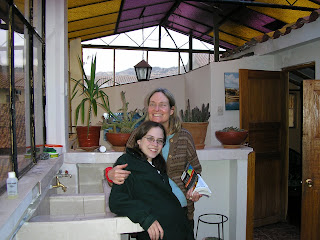
Mom and Marissa in our first hostel. It was cheap, no heat, but generally clean and the sun warmed the top floor where we were during the day. The only problem was that Mom's rooom smelled really bad because when the toilet flushed it kind of sprayed little drops out onto the floor... she didn't stay there for long.

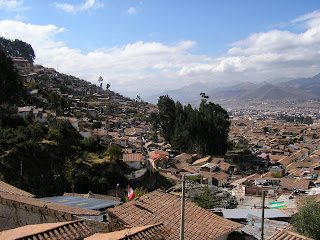
The first day I was lightheaded and short of breath from the altitude. Coca tea, an infusion of the leaves that the native peoples chewed for extra energy in wandering through the mountains and modern people now refine into cocaine, helped. Marissa felt sick at lunch and so Mom took her back while Catherine and Chrissy and I wandered the city. Cusco is absolutely beautiful--all the buildings are white with orange-brown slanted roofs, and the mountains surround it on all sides. It's so isolated, and the air is so fresh and clear, that it really does seem like it might be the center of the world the way the Incas thought. It also helps that the city revolves completely around tourists now, so everything in the center is kept beautiful and entertaining. In our wanderings around the plaza at night, I bought alpaca socks and Catherine found a dress for her sister's wedding, of all things.

(Light and shadow in Cusco is amazing.)


On the first morning, Catherine felt a little sick to her stomach, but she stayed in bed and was better by lunch. The rest of us spent the morning in administrative details: first getting another hotel room for Mom, in the beautiful tourist hotel around the corner from the cheap hostel, then buying our train tickets to Machu Picchu, then our bus tickets for the end of the week from Cusco to Arequipa. It was beautiful and sunny and I was loving the incredibly clear, fresh air, even though we hadn't "seen anything" yet. Then after lunch Mom felt sick with a fever and chills. She went to lie down in her new (heated) room. Marissa and I went and bought the last of our many tickets, the "tourist ticket" that admits you to many of the sights around Cusco... but then discovered that it didn't let you into any of the churches, which was what we wanted to see. In retrospect, I should have just paid the 10 soles and taken my sister in to see something already, but I was so sick of spending money on tickets that I wanted to actually use one of them. So we walked through the museum of the Quorikancha temple site, where the Church of Santo Domingo now stands. It was small and not very interesting.


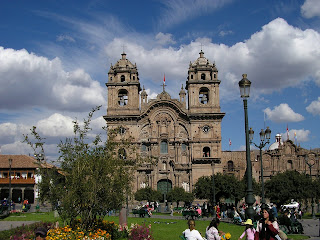
Iglesia de Santo Domingo, from the outside, with a random guy's head.


One thing we could use the tourist ticket for was a performance of native music and dance at the Cultural Center in the evening, so we did that. It was full of brightly colored costumes and traditional huayno music, which uses a lot of string instruments and high-pitched voices all on the same (often very repetitive) melody, and dances with a lot of little foot-stomping jumps and interesting interactions between the dance partners (at one point the men put ropes around the women, at another the women kicked the men to the floor). We hear a ton of huayno in Tupac, and it gets really old really fast when your neighbors play it really loud for twelve hours straight on a Sunday to celebrate their patron saint--but it wasn't annoying at all in its natural setting, so to speak, of Cusco and the traditional dances. I feel like I understand it better just from seeing the landscape it comes from.


On our second morning in Cusco, Catherine, Chrissy, and I woke up early to go hiking. At last we were going to really explore the city. We followed my guidebook's directions up small cobblestone streets between white walls, up to an old, out-of-use church with a view over the whole city. On the way was a street called Purgatorio. This is us in Purgatory.


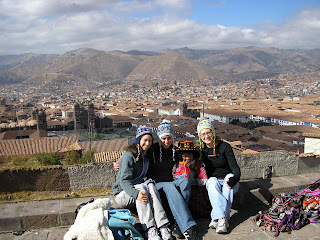
This is us on the church's plaza overlooking the city. By this time we were all hopelessly addicted to chullo shopping; here we are wearing some of the first ones we bought. I bought a belt from a señora here who showed me how she weaves them by hand.
We contiuned up the road and out of the city, up a hillside, shopping for more chullos and other gifts at the tourist stands set up along the way, to the ruins of Sachsayhuamán. It was a beautiful day and we took our time rambling around the remains of the Inca fortress that once stood there...


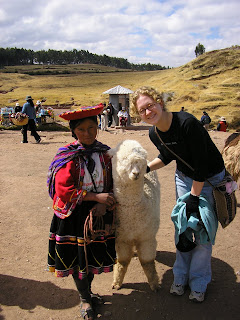




...and we met llamas!


We walked down the road to another hill, where there are ruins of the ancient temple Q'enco which was used (I found out from eavesdropping on a tour guide) for ritual sacrifices and telling the future, among other things. You could go inside the temple underground and walk around the tunnels, and we saw where they would pour chicha into rivulets in the stone to predict the future by the paths it took. We took a picture of me as a sacrifice on the stone tables, but unfortunately it was on Chrissy's camera and not digital.

Meanwhile Mom (who was feeling better) and Marissa went out to see the inside of the Cathedral, which houses a famous painting of Jesus at the Last Supper eating cuy (guinea pig), a traditional Cusqueñan dish. By the time we met up it was evening. They were in yet another hotel, because the nice one they'd found had only one night available; this one was cold because the room got no sunlight, and now Marissa was sick with the same chills and fever.

I went out again to go to Mass and to bring foodstuffs back to the hotel, feeling very tired and anxious about us getting to Machu Picchu. The church on the Plaza had an altarpiece two stories high and so covered with gold leaf that it hurt to look at, especially after all the sun we'd gotten that day up on the hills. The plan was to set out early the next morning to take buses around the sites in the Sacred Valley, arriving by 7:00 at the town of Ollantaytambo, where our train would leave for Aguas Calientes, the little town at the foot of Machu Picchu itself. The buses don't go any farther into the mountains than Ollantaytambo because the hills get so close together that it would be too difficult to put in roads; everyone who goes to Machu Picchu goes by the train, which follows the river winding in through the mountains. I hated the idea of leaving Mom and Marissa behind, but the train tickets couldn't be moved to another day.

That night I myself got the chills, at which point my goal went from getting everyone to Machu Picchu, to not dying and leaving my mother and sister stranded in a cold hotel in Cusco. In the morning I felt fine, but now Chrissy was sick and Marissa was still not up for the journey. We called the taxi driver/tour guide who had given us a ride from the airport, Josué, and asked him to drive us to and from Ollantaytambo as an alternative to taking the bus. He said he could do it for $40 each way; then he came to talk to us, we agreed on a time, and he went from $40 to $50, because he could see we had no other option if we wanted to get to our train. So we said okay. Meanwhile Mom had managed to contact an English-speaking doctor through her travel insurance and get him to come see Marissa and give her medicine to take. In the afternoon we moved Mom and the still-feverish Marissa to their fourth and final hotel, upscale and heated like the second one and much more comfortable than the third, and left for Ollantaytambo with Josué, our luggage, a still-half-sick Chrissy, much angst and guilt, and those precious, non-transferrable train tickets that were going to take us to Machu Picchu.


Tuesday, August 7, 2007

Visitors in Lima!

Well! Quite a lot has happened in a short time during our mid-year vacation. I'm back in Lima now and feeling surprisingly rested, or at least refreshed, after a trip that rivals National Lampoon for things gone wrong on a vacation. The good news is that I got to see the sun, Cusco, llamas, the sun, Machu Picchu, the sun, about 27,000 chullos (those Andean wool hats with the ear flaps), the Sacred Valley of the Incas, and most of all my mom and my sister. And the sun.

On July 21st I went with Carlos the taxi driver to pick up Mom and Marissa from the airport. I realized that I really like airports--I love going, being on the road to a new destination, and also meeting people who are coming to see me, and airports are good that way. Having my family come visit was the next best thing to visiting home myself; since I couldn't go home, home came to see me. Marissa had finished the new Harry Potter on the plane and I'm not sure she entirely stopped thinking about it at any time during the two weeks that followed. She felt a little out of place because of the language barrier and being the only teenager around, but Mom was fearless, jumping into any and all conversations with whatever Spanish she had available. This was actually quite a bit, and she got along with the sisters (and pretty much everybody else in the pueblo) as though she'd known them forever--chatting with the people in our English class, meeting the music group after Mass and trying out her skills on the drum, telling slightly weird stories about her friends' pets during our welcome lunch with the sisters, etc. It was great. As always, the sisters were amazingly hospitable. They cooked us a wonderful lunch the first day the visitors were here, and Iris gave up her room for Catherine's friend Chrissy who also came to travel with us.
We did a little tourism in Lima the first few days. This is us in the Convento de Santo Domingo, where we learned about San Martín, my new favorite saint. Our friend Ever took us around the city center and we saw the cathedral, which was very impressive. (Only about an hour after the tour ended did I realize I had actually seen the same cathedral before, in February with the volunteers from Tony's... clearly Peru is driving me out of my mind...) There was sun on the Plaza de Armas and very crowded buses on the way back home.


The Cathedral of Lima...


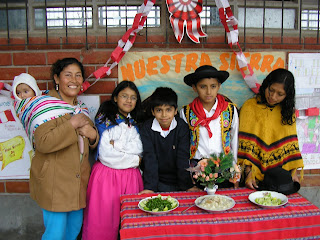
Mom and Marissa also came to my English classes at the school and in the parish. My students really loved asking Marissa how old she was and where she was from, since they are the same age. On the last day of class before the Fiestas Patrias vacation, the school puts on a display of typical Peruvian foods from the different regions of the country, so our visitors got to see that, plus my chorus sang everything they've learned so far in front of the rest of the school. It was darling and they were so proud of themselves.


Wednesday night the sisters said goodbye to us with a lovely little bilingual tea, and on the morning of the 26th our journeys began...


Monday, July 9, 2007

Normalcy

There is a teachers' strike going on right now in all of Lima and maybe more of the country. The teachers want better pay and benefits from the government, and those from our school have decided to support the national movement. So today and tomorrow, at least, there are no classes. Catherine and I agree that we have never seen a student body miss as much class time as the kids here do--the past two weeks were both 3 days each, one because of the day off for Teachers' Day, and the other one for Saint Peter's feast (I think.) Since it's boring to miss classes and feel like we are sitting around with little to do, last Thursday we went back to visit the Hogar in Chaclacayo for a day. It was great to see the kids again and equally great to see the sun! Chaclacayo is less than an hour outside Lima, but the weather is completely different because of its elevation and position relative to the mountains. Since tomorrow I have no private classes outside the school, I'm planning to go back for another day.

One of our friends from Chaclacayo, Ever, came to visit us last Thursday and went with me to accompany the Pastoral de Salud on their visits to the sick. He saw Señora Rosa in her shed with her bent hands and seemed even more shocked and troubled at the sight than I was. The next time he came to visit us, he arrived in a mototaxi with several bursting grocery bags full of "viveres"--rice, salt, teas, pasta, canned milk, and other nonperishable foods--ready to distribute to the people here who need them, bought with money that he and his friends in well-off Chaclacayo pooled together. It reminded me of my parish at home making sandwiches in the basement after church to take to soup kitchens in downtown Baltimore. I was really touched by the generosity of Ever and his friends, not least because I saw something of myself in them, foreigners to the world of poverty but eager to help a little if they could figure out how. After church Catherine and I helped to divide the things into ten bags and take them around to different houses with Estela, the unofficial angel of the parish who knows the needs of all the poorest people in the area. It was only a little bit for each person that way, but nonetheless it seemed almost like magic, all this good stuff appearing out of nowhere to fill the "viveres" baskets.

Besides all the missed class, things are going along more or less normally. Often on weekends we go out to the discotecas in Barranco, and little by little the Peruvians are teaching me to dance. Yesterday I bought a merengue CD, my first Peruvian music purchase. It's cool to realize you've been somewhere long enough to recognize the songs played on the radio and in the clubs. I have yet to see an original CD or DVD being sold in this country--I'm sure they exist in expensive stores in Miraflores, but in every market you go to, there are tons and tons of CD's and movies being sold, every one of them pirated. It's what the people can afford to buy-- S/. 2.50 for a mix burned off someone's computer. The vendors (I think) create the cover inserts, which all tend to follow a certain style of tacky bright colors and computer-generated images. They list the songs, the CD title ("Merengue MegaMix 2010," "Salsa de Oro," "Super Bailable"), and always, always feature pictures of mostly naked women in poses that do not inspire respect on the part of the viewer. When I first came here I couldn't believe that anyone would hand a child a CD in a case like that and say, Put this on! But that's just the way it is. Not even the women seem to think it's odd to have what looks like a Playboy model staring suggestively at them while they read their song list. The blonde on my merengue CD looks a little confused, as if I'm not quite the person she was expecting to have looking at her; we have a tacit agreement to ignore one another and are getting along well that way. The CD has my favorite song, Noches de Fantasía, and is very "danceable" as they say, so it's all good. A few weeks ago I also bought a zampoña, which is a traditional Andean panpipe. It's great--the kids at Tony's and my friends in the church choir are teaching me to play El Condor Pasa and other traditional melodies.


I'm still struggling with feeling useful enough, mostly because teaching the same two lessons of English to every kid in 3rd and 4th year at school is really boring, and every time I try to start private classes outside the school, the people show up for 2 weeks and then stop coming. But I do have one student who comes every week without fail, Mondays at 11. He is a very sweet 30-year-old who looks 25 and seems very childishly innocent. He was studying English with Sister Denise before she left, and now he's asked me to teach him how to use a computer, because he had never used one before. So far we have progressed from poking the mouse cautiously, as if it were a live creature, to Googling things like dolphins or rivers or Machu Picchu and scrolling down the page to look at the images. Often after about ten minutes in the Internet cafe he will stop what he's looking at to produce a little gift for me, like chocolate, a scarf, gloves, a piece of the cake he baked yesterday, a fake rose with a plastic heart attached, etc--a source of endless amusement for Catherine and Teresa. But he's so shy that he never says anything more forward than "I'm going to miss you a lot when you go to Cusco... you know, you get used to the person who teaches you." And in a way, I like our Monday morning outings, when we talk about what we did over the weekend and how our families are doing. It's nice to have a Peruvian friend like that.

...speaking of which, next Saturday my mom and Marissa are coming! And we're going to Machu Picchu! I cannot wait to see them and get out of this miserable Lima weather.

Friday, June 22, 2007

Health is money

I've seen two very different worlds related to sickness in the past week and a half. Catherine and I went to the Clinica Stella Maris, a first-rate, first-world, modern and clean and highly professional cross between a doctor's office and a hospital, to get ourselves checked out for parasites. Ever since February we've both had recurring stomach problems--Catherine gets sudden and intensely miserable bouts of diarrhea, takes medicine, gets better, feels fine, and then does it all over again the next month, whereas I never feel quite as bad as she does but almost never feel completely normal either. Sister Teresa said she had parasites for two years once before she realized there was a pattern to her stomach issues and got analyzed. So that's what we're doing. The clinic is over an hour away on the bus, but it's where the sisters go, and as soon as I got there I knew it was worth it to go somewhere really trustworthy. The doctor was very kind, very professional, and acted like he had all the time in the world to talk to you, which was a welcome change from some doctors in the US. (Of course he doesn't do appointments, he just takes people as they come, so after the hour-plus bus ride we had to wait an hour and a half to see him... the good side and the bad side of the Peruvian approach to scheduling.) He even pronounced my name correctly and knew a few English words (like "bloating") to help me describe my issues. Going to the doctor in a foreign language, especially for stomach/bowel issues, means a whole set of fun new vocabulary words!

The doctor's visit was 50 soles, or about 17 dollars; the analyses all together are about 255 soles, or 85 dollars. My insurance with Notre Dame Mission Volunteers is going to reimburse me for most or all of this. Once they get done with the analysis we'll see what parasites we have and then get rid of the pesky little critters.

All this is unbelievably different from what I've seen when accompanying the parish health committee to visit the sick in our pueblo and take them communion. A few women from the parish spend their Thursday afternoons doing this, and the houses they visit range from modest to very poor. Yesterday's patient was a thin old grandmother with doubled-up hands, maybe from arthritis or something like that. She could sit on the edge of her bed but couldn't walk. She wore a hat because she had recently shaved her head to get rid of lice. Her house wasn't really a house at all: she had a little room like a shed, with a lightbulb overhead and cloths shoved into the gaps between the tin roofing and the walls, and a few yards down the hill was another bigger shed that I didn't see inside. A wooden board fence with a swinging door went up the hill to the right of both, and inside it was a sort of yard area at least partially roofed over. (The roofed part that I saw inside may well count as a legitimate house around here, because even nice houses in Lima sometimes have little areas open to the sky above, or whole back walls missing where a room leads right into a backyard. It never rains enough or gets cold enough here to make people seal themselves off completely from the outdoors.) The yard seemed to be where the woman of the house, the patient's daughter, did cooking and laundry. There was laundry strung up on lines everywhere, and farther up the hill a few old couches and bicycles lying around rusting outside. Here and there piles of stones outlined the paths where the daughter and the granddaughter and the dog walked back and forth through their home.

The grandmother, Señora Rosita, was very lucid and in pretty good spirits; her sister-in-law was there visiting her too when we arrived. Her sweet 7-year-old granddaughter hung around in her doorway keeping the dog out and singing songs with us. The daughter was a well-built woman in her 30's who came out from doing her laundry to talk to us. When Señora Rosita complained that she never brought her to church any more, she said firmly, as if she had been over this a million times to different visitors, that she would love to bring her mother to church, but she has no time. Every day she gets up at 3:30 in the morning to cook and take the food to the market to sell by 6 am. After selling all morning she comes back and does house chores and cooks for the family. If she doesn't do all this, she said, "what am I going to give my daughter to eat? The truth is, I'm a single mother. If I don't sell, what am I going to give my mother?" But even after telling us all this, she stayed to listen when the woman I was with told her about a special Mass for the sick, and asked when and where it was just in case she might be able to take her mom. She left us to go back to her laundry with the air of someone who knows her job and is going to do it.

The family seemed to get along well and be more or less in good spirits. The little girl goes to school and she could read the song book I had with me. So they're getting by from day to day. But what killed me was that Señora Rosa told us about the herbal soup she makes to help the pain in her bones, because they can't afford the medication she used to take. "Three for five soles, señorita! It's expensive!" Three for five soles is fifty cents a pill. Fifty cents a pill, if she takes one per day, is one hundred thirty-two dollars and fifty cents a year. After she said that, I had a surreal sense of not understanding the world I was in. The fence, and the dog, and the shed with the grandmother's bed and her wool blankets to keep warm, the strung-up laundry, and a couple of flies buzzing around the door--and more than feeling sorry for them, I felt a confused sort of anger. I didn't get it. Why don't they get a real house? I found myself thinking. Why can't they go get their grandmother some pills for God's sake? It's so easy! You just walk down to the pharmacy and get them! I had an urge to shove a couple hundred dollars into the daughter's hand, wordlessly, not as if it meant anything, but because it meant nothing--because the pile of dollars sitting in my bank account suddenly seemed so worthless to me. Here, just take it, I would say with a look. Your mother needs pills? Buy her a whole year's worth of freaking pills, they're only fifty cents each! How about a real roof for Grandma? I'm not looking to be your benifactress or anything, it's just that it's so simple! Where I come from you just take your money and go buy what you need...

In the face of fifty cents a pill, I don't know what good it really does for me to teach a little English here. (I have taken a "break" from my Communication classes because I had no clue how to teach Camus's The Stranger, and decided I would rather spend my time on other activities than try to design and teach a high school literature curriculum in a foreign language with no control over what texts are read and no guidance from more experienced teachers. Pati understands perfectly and gave me an open invitation to come back whenever I like or not at all. She is a very sweet, generous person.) Who knows whether my efforts will actually improve the lives of any of my students, especially when the progress is so slight and slow, and the ones who say they are interested in more intensive tutoring never show up when they say they will. Maybe they will make a little progress, but after this year (or next), I will eventually go back to the US and leave them. Going to the US is something many people here would like to do, but few can. But for me, it's the easiest thing in the world to go back home--to flash my passport and skip through customs and immigration to a life in abundance where everything I could ever need is always there for me. It seems a little wrong to do so while Señora Rosa is still living in her shed.

I want to swear that I will never look at a $20 bill the same way again. But I probably will, in the future, go back to seeing it as a coffee and a movie instead of a week's worth of dinners for a family.

...in other news, my fourth grade chorus cheers me up every time. They are so cute and they are singing so well.

Friday, June 8, 2007

Things you can do, and things you can't do

I haven't seen the new Pirates of the Caribbean movie yet, but lately I keep thinking about a quote from the first installment. Johnny Depp says to Orlando Bloom, while the latter is hanging precariously off the side of the ship: "There's two kinds of things in life: things you can do, and things you can't do. Either you can accept that your father was a pirate, and a good man--or you can't. Now, I can let you drown, but I can't bring this ship back into port all by me onesy, savvy?" As far as I know, my father was never a pirate, so that part of the speech has little bearing on my life. The last sentence, though, is how I've been feeling lately about several of my projects here, particularly Communication, and I'm discovering that a big part of the international volunteer experience is figuring out the difference between the things you can do and the things you can't do, and then learning to live with that.

For those who don't speak Captain Jack Sparrow, "all by me onesy, savvy" means "all by myself, got it?". The more I come to understand how Fe y Alegría works and what it needs, the more I realize that the things I would really like to do for these students are impossible for me all by me onesy to accomplish. What the students need is an English class that teaches them to really use the language instead of just memorizing phrases. What they need is a Communication class with a planned syllabus, where they are informed well ahead of time of all their assignments, where they are taught first to write paragraphs taking evidence from the text to answer a question and then to put those paragraphs together into essays, where they have homework that asks them to think instead of just to fill up their notebooks with summaries of each chapter they read. What they need is a real music teacher who would know how to coordinate the various vocal and instrumental talents of the students into a well-organized group or two. In other words, to truly fix the things I'm working on would take no less than three full-time teachers doing their jobs impeccably. Essentially, what the students really need is... not to need us.

But they do need us. However frustrating it is for me to look at this school, analyze where it is now, come up with some changes that would be essential to giving these students an excellent education, and realize that those changes are impossible, the immediate reality is that this year I can help a few students move a little closer towards that excellent education they aren't getting. Instead of patching up the leaks in the boat, we're bailing. Not a permanent fix, and by itself it won't bring the ship back into port, but it helps a little in the meantime. It's hard for me to work this way because I've always been a big-picture person. When I do things, I really do them, and I'd rather do one thing well than many things poorly. I get stressed out when (for example) I realize that the kids aren't going to have their reading questions for Monday because both they and I have just been given Monday's reading on Friday, and I can't demand that they take a quiz on the reading because I wasn't given the opportunity to tell them that there would be a quiz, so Monday will be yet another day of nobody having read and me not knowing what to do with them--in short, when I can't make the class "work." And I think, I can stop doing this if I want; I can walk away, dedicate myself to English classes instead, and let these students "drown" without something solid to hold onto in this class; but I can't fix it alone because I'm not the teacher. But then the next week I do manage to give them questions, and we talk about the setting and plot and start analyzing the characters, and they have fun re-telling Treasure Island from John Silver's point of view, and it's so clear that they need what I'm doing that I really want to continue.

So it turns out that much more difficult than either letting them drown or bringing the ship back into port all by your onesy is doing neither: staying with it even though it cannot ever really "work," learning to live with doing something halfway because halfway is better than nothing. A very difficult lesson for me. But this whole world of Peru is full of things that are different than I'm used to. Less academia, more cooking and cleaning; less news from the US, more freedom to be Catholic without the difficult politics of Christianity right now in America; less structure, more flexibility. Peruvians in general are not as stressed as Americans, and I'm trying to learn from them to just live with a little failure.

Meanwhile, my English groups are more or less under control, and by the end of the year if nothing else I will have taught "to be," the question words, and adjectives for describing people to every student in 9th and 10th grades in this school. It makes me laugh that I usually have class in an auditorium with holes in the roof where birds fly through, and my dry-erase board has stains on it from bird poop (so far I myself have been lucky). My fourth grade chorus is absolutely darling and often the highlight of my week. They are learning to sing in tune and working on doing rounds, and I hope to take them to a city-wide arts festival in November where they can perform and listen to other student groups! Some of them are so unbelievably excited about singing, they always yell "La señorita de canto!" ("the singing teacher!") whenever I appear, and they give you kisses on the cheek to say hello and goodbye. The secondary chorus has issues with showing up when they're supposed to, so I may be cutting out the Thursday rehearsal in order to accompany some of the parish women in taking communion to the elderly--something I have done once and am interested in doing more. The only other news lately is that Peruvians are constantly having parties. Last week was our friend Sara's birthday, Sister Denise's goodbye dinner, and Sister Magda's birthday all in one week. All the ice cream and cake is probably not good for me, but the celebrating sure is fun.