Thursday, April 10, 2008

Semana Santa, part 1

Finally, I get to write about Holy Week! It's been hard to find time to blog.
Back in late March...

I was just getting over my sickness and almost through auditioning kids for the choirs. (But I hadn't returned to the doctor yet; I was still coughing. Apparently it was an allergy in my lungs that was making me asthmatic. Stupid smoke in that discoteca. An inhaler and prednezone, when I finally went back to see Ana María again, did the trick.) The weather was very warm compared to the same time last year, especially in the sun during the day. It gave me hope that maybe this year the winter will be warmer than last.

At this time last year I was just getting to know people--Good Friday, in fact, was the day I met Eymi, Luis Alberto, and Alfredo in the Via Crucis procession and asked them about the church choir. That night I went to my first rehearsal, and the rest is history. But now, this year, I was one of two guitarrists leading the Palm Sunday procession from the church to the soccer field for Mass, singing all the versions of the Holy, Holy that we know. It was 6:30 am and the sun was just coming up. The women here always bring baskets of beautifully woven palm creations to sell at the Palm Sunday service, crosses, abstract designs, decorations, etc.


my beautiful friend Rocío, who sings in the group that did the CD last year

me and the cool palms that Robert and Adrian bought for me

I kind of suspected that during Holy Week I would get stuck leading and organizing things I really didn't know how to lead or organize, because other people wouldn't show up. And that's precisely what happened. But the miracle was that I didn't get too stressed out or upset. On Holy Thursday, the choir, like other parish groups, was expected to offer a reflection during the vigil after Mass. But, naturally, we hadn't come up with anything beforehand--perhaps because nobody told us we were supposed to until the end of Monday night's rehearsal, which was the last one before the Holy Week services began. Right before the service I grabbed hold of two members of the choir who came early, and worked out with them a little presentation of that day's reading broken into parts and interspersed with verses of a song. The idea was BJ's, but the organization and execution ended up being mine, and it turned out pretty well. During the vigil I also ran back to the house to grab a psalm book because Eloisa, the only other girl who'd had an idea for a reflection, showed me the psalm she wanted to read and then LEFT after Mass! Ah, Peru. The vigil ended up being very pretty, music and readings in a candlelit church until midnight, and I felt excited at having made part of it happen.

On Good Friday, instead of praying the Stations of the Cross in the church, the parish's tradition is to go out walking around the barrio to the houses of fourteen sick people, and at each house to offer prayers, songs, etc. Magdalena was having more fun than is traditionally appropriate on Good Friday playing with the megaphone: there is always a megaphone so that the people can hear the songs and prayers, and so that they stay together while walking and singing between houses. It's not weird here for people to troop around their neighborhood for hours in a sort of loosely united group (definitely not a procession or parade), with one person holding up a big crucifix and someone else singing into a megaphone, making a bunch of noise with guitars or drums or sometimes big brass instruments that go BBBRRAAWW! while the neighbors are trying to sleep or whatever.
Alfredo and I showed up to be the musicians, but nobody could find the special Good Friday song sheets, and so the ladies of the Pastoral de Salud started asking me, Catalina, what are we going to sing? Um...?? I don't know! Why don't you ask someone who, for example, has been in this parish (in this country) for more than a year and knows what songs are normally expected for Good Friday and knows how to play them! But since Juancho, who said on the phone that he'd be there in ten minutes with the song sheets, never showed up, we just grabbed the regular sheets and started off. Estela read the opening prayers into the megaphone and then Alfredo and I began the music and we started walking under the hot sun. I didn't want to be the one singing into the megaphone, but other people's inability to sing the actual correct notes of the songs soon landed me with the job. (Alfredo and Eymi did sing a bit later on when I got tired.)

It was hard to be present to the ceremony, the prayers at each person's house, because I was constantly thinking about what song we could sing next, trying to vary the repertoire while keeping with the themes of repentance, mourning, etc. And while I was more or less stressing about this, an 11-year-old stranger began hanging on me. It was the weirdest thing. All along one leg of our walk she stayed near me, staring at me in fascination; I just smiled at her and kept singing; then she came up and walked at my side, resting her hand on my arm as if draping herself on me, as if to say, Hug me, walk with me, pay attention to me, give me affection!--and I had no idea who she was! I was totally freaked out and wanted to say, Who are you and why are you touching me?! Later when Eymi came along, she started hanging on her, when possible walking between us to hang on us both at once, and it was obvious that they knew each other... so maybe she just figured I would give her affection by association, seeing as I was also a young woman singing in the church choir. WTF, mate.

So I spent all afternoon tramping around the dusty streets of Tupac singing into a megaphone with an 11-year-old stranger fawning all over me. One of our stops was at the wake of an elderly man we'd been visiting with the Salud group. It was sad... but it was nothing compared to the second wake, which we found unexpectedly along our route and just sort of got called into. A 21-year-old woman had died from complications with her Cesarian section. (Apparently the baby did survive.) Her family was just absolutely in pieces. They looked like they could barely move, think, register what was happening, because of the unbelievable weight of the grief. Estela spoke a little and we tried to play comforting songs. Heavy, heavy stuff. I think was especially shocking for BJ, who hadn't seen the "houses" some of the sick people live in around here.

Sometimes the people we were visiting came outside, sometimes we sang to them from their door knowing they could hear us. People I knew appeared, walked for a while, and disappeared again; I made Alfredo switch with me because I had no voice left after 9 of the 14 stations. That night was a service in which I, with the help of the women of the choir, once again chose songs on the spot because nothing had been planned in advance. It was exhausting, but rather than feeling stressed out and abandoned by my friends and fellow musicians, I just went along with it. When people wanted things from me that I couldn't give, I just explained that I didn't know that song. The more frustrated I could have been with those who didn't come, the more gratitude I demonstrated to those who did... and I ended up with a feeling of, We did it!
I definitely think I lost a few pounds that day.

Living in Tupac = craziness

So as my tutoring is not really set up yet, I'm not spending as much time in the school as I would like to or as I feel I should be. BUT... I would hardly say that when I'm not in the school, I'm doing nothing. Tupac is different from Delicias in that respect: there are so many things that need energy and attention in the house itself, that I feel like I've hardly had a free minute all March.

The house is in the center of the town and literally connected to the church, a location that means NOISE. If it's not mototaxis blazing by or the cantinas on the next corner blaring their music all night on Fridays and Saturdays, or some event in the park broadcasting cumbia to the world--it's people knocking, knocking, knocking on the door to ask about anything and everything connected with the church. There's a sign outside our door listing the days and times when people can go to the library to sign their kids up for religious ed, but darned if anybody reads it. At least a couple times a week it's, Ring ring!--"Buenas noches, Sister! About signing up for catechesis...?" In the US people always read the sign before asking for help. Here it's the opposite. I want to tell them, READ THE FREAKING SIGN, people! Signs are for people to READ so they can have INFORMATION without having to bother the nuns! (or volunteers, or whatever. I've gotten completely used to being called Sister by this point, and I kind of enjoy it. It makes you feel nice, like people know you're there to help.)

I've learned many but not all of the key rings to open various doors and rooms and temples for the people who come to use the church (usually about five minutes after I sit down to eat dinner.) And I've adjusted to the little things like cleaning the bathrooms once a week (in Delicias we paid a friend of Iris's to do basic cleaning) and hauling water a longer distance from the wash area to flush the toilets with. In this house, there is water provided by the city, while in Delicias the community buys it from a company that sends a big tank truck every month; but it's still good to save water, because sometimes the water provided by the city cuts out. In that case, we are lucky enough to have a well from which we can pump water up to a tank on the roof, and from there it falls through the pipes to the house. Last week the area's water cut out for about two days, and people were standing outside their houses with big, not necessarily clean buckets to buy water from a tank truck that came driving by, with a guy on the back hopping down to make sure the hoses went into the buckets... not, as I realized I had half expected, nice plastic jugs being handed down one by one without any splashes or dirt.


buying water from the truck

Our community in this house is a new one and we're still trying to find our feet as a group. Magdalena has lived in this house for several years, but I'm new to the house, and Sister BJ is new to Peru: she's been here three months now and is dedicating herself to Spanish classes before she can take on any ministry in this country. For a few weeks there was Fransisca, Elena, and Rubén, but mostly now it's just Rubén, because Elena spends most of her time in the hospital attending to her mom (or being operated on herself for appendicitis... you know, whatever...) It's a huge responsibility having a kid in the house. We have to cook lunch by 12:00 every day so he can get to school by 1, make sure someone is always in the house when he's not in school, help him with his homework, tell him to turn off the TV and go to bed at 10:00, get him up at 8:30... and as far as his laundry, I don't even know if he does it himself or if Magdalena does it. He is a great kid, but he's a kid, something none of us is used to having to care for.

And from his point of view, I'm sure it must be hard for a twelve-year-old from the rural north of Peru to be suddenly plunked down in a convent with three foreign women trying to care for him while his mom's sick. It's difficult, too, for him and BJ to understand each other. He talks too fast for her, she puts in English words that he has no way to understand or makes mistakes that interfere with her meaning in Spanish, and he has no idea what she's saying, and then later she ends up feeling like he doesn't respect her when she reminds him it's bedtime or tells him to get ready for lunch. I can't entirely blame him for this, as it's hard to take seriously someone who talks in a strange, funny version of your language. Also, I've discovered that even Magdalena is often not good at speaking Spanish in a way BJ will understand--using simpler grammar or words she knows instead of resorting to English. Maybe it's my practice as an English teacher here that makes me more sensitive to the kind of Spanish that BJ needs to hear and practice, or the lapses in communication between her and Rubén...

If it were understood that I was supposed to be the translator and everyone knew that, it would be easier in a way. I'd just translate and people would understand each other. But in order to let BJ speak and understand on her own as much as possible, I try to fill in only the most gaping of the gaps in communication, helping get a few key words or ideas across--in other words, I spend a lot of time listening in silence to people's struggles to understand each other. Very difficult for me, "mediator"-type personality that I am. It stresses and upsets me when communication breaks down and there are misunderstandings.

Besides our immediate community, there's an eclectic collection of people who sort of hover around the house, appearing once or twice a day or maybe every other day, needing things from you. (Or rather from Magdalena, but from me or BJ if she's not there.) Most constantly present is Ana. Ana is a 40-year-old woman who used to live on the streets because she was abused in her house as a child. When she slept in the park, Magdalena says, she used to carry around metal bars to defend herself with at night, and once she was taken to the police for carrying around a knife and frightening people, yelling, etc. She has a child who is being raised by her extended family. But now--I don't know how these miracles were accomplished--Ana takes medicine to stabilize her mentally; lives in a little room that her siblings rent for her, two streets away; takes a shower in our back bathroom twice a week; does her laundry here; sweeps our sidewalks and takes out the trash and recycling every day, for which Magdalena pays her S/. 3.50 per day out of a donation she received for Ana; and is calm and pleasant in her interactions with us. If you talk to her about something she likes or compliment her on her looks, she gets a big smile on her face and will tell you where she got her new blouse, etc. Magda says that a doctor once told her, however you treat Ana, that's how she's going to respond. So Magdalena is all praise for Ana's work, her laundry-doing, her taking the recycling to sell--and Ana rings the doorbell around 7 am every morning and comes in with a comfortable "Buenos dias," as if we were expecting her. Which, it seems, we are.

Apparently it was Estela who originally brought Ana to the sisters, and for a long time she slept in the parish multipurpose room and wandered the park during the day, and one step at a time the improvements came--no doubt through the persistent work of Estela and Magdalena. Ana also loves to sit in the garden and look at the beautiful roses, white, red, pink, and yellow, that she helps to water.
the garden on our patio.

Oh... and Ana also brings fleas into our house. I've become more or less accustomed to the odd flea bite now and then. Magda fumigates the house every so often, and I have branches of eucalyptus leaves, a big bunch for 50 cents in the market, strewn under my bed... it does seem to keep them away. But poor BJ is way more allergic than anyone else to the bites, and suffers for weeks after being bitten, whereas for me a flea in my room means I get a couple of red dots on my stomach or ankles and itch a little for a few days. Change the sheets, sweep the floor, and bring in more eucalyptus, usually does the trick...

After Ana, there's Jorge, a young man who works in the parish library and has all sorts of family issues that he talks to Magdalena about. For a while he was sick and thought he might have tuberculosis, but he doesn't, thank goodness. His mom is absent from the house right now, so we usually feed him some dinner when he comes at 5:00 to do his work. Apparently there's also a Miguel who works in the library and suffers from depression, but is taking medicine now and starting to take more control of his life. There's Modesta, who always buys the flowers for the church and occasionally wants the money from Magda (who is in charge of handling most of the parish funds...)
And less often, there's Estela and her group of ladies who visit the sick and need help and support in attending to them. Today I went with Estela and ended up singing Happy Birthday (outside the house on the street with my guitar and everything) to a woman with an amputated leg and bed sores that she hasn't gone to the doctor for, because she has no money. The group decided to give her 50 soles for now to pay for a visit and medicine for her infection, and go from there.
All in all it seems like there's never a free minute. Thank God for my Mondays, which I have left free for myself as my day off, since Saturday and Sunday I teach a couple of English classes and am generally busy in the parish. Last Monday I escaped for a few hours to Barranco, the artsy, bohemian-backpacker-chic section of the city, where there are parks with trees and grass and beautiful views of the ocean. I do love living in a city built around a bay.

Wednesday, April 9, 2008

Auditioning singers, setting up tutoring (sort of)

After getting over my illness (mostly), I jumped into auditioning kids for the 4th and 5th grade choirs in Fe y Alegría. What a job. Almost everybody is interested in singing, so I have to listen to every kid in the two grades, about 170 little Peruvians all told. I took them out of their classrooms in groups of 6 or 7, taught them a little song, rehearsed it several times, and then listened to them sing it in pairs (or alone if they wanted to.) In honor of last year, the fourth grade all sang "Los Pollitos" ("The little chickens"), but 5th grade graduated to a more grown-up-sounding church song.

I was listening for the basic ability to stay in tune, alone or with me or with a partner. It was really fun for me to play around with the different voices, see if this person can stay in tune if they're next to this one who's a strong singer, see if these two can hold the melody without the third, etc. Both grades this year seemed vastly improved from last year's fourth grade auditions, when it seemed I could hardly find anybody with good pitch; this year there were lots, especially lots of boys, so that I even had to do callbacks to get the numbers down to 22 per choir. With the behavior of these kids, especially the fourth graders, more would be simply chaotic.

I had four afternoons in the school to do my auditions before they had a four-day weekend for Holy Week (which deserves a post of its own so I won't talk about it here.) Then suddenly it was the last week of March and I didn't even have choirs going yet, let alone the tutoring work that I'm supposedly doing! Part of the delay is due to my Mondays off: since I teach classes on Saturday mornings and do parish things on Sundays, I have claimed Monday as my free day on which to do NOTHING. (or on which to plan my English classes, arrange songs for the choirs, do my cleaning, etc.) I finished the final cuts for the 5th grade in typically Peruvian, spur-of-the-moment style: stuck my head in the door of class 5A and asked the teacher if I could steal certain kids; was told that the Ministry of Education had monitors there that day so I couldn't take anybody out that day; went to the library to organize my lists, and was discovered there by a bunch of curious kids as soon as the bell rang for break; told those kids to run and get me the people I needed to listen to again; listened to them in the middle of all the noise in the library, and then I had my 5th grade choir. There was a big group listening, eager for news of who'd made it, and I had to tell them all to run and play during their break and that I would come on Friday.

Fourth grade has now had two or three rehearsals, and they have good pitch but awful behavior. They don't really know how to be a choir... which last year's group didn't either, so I guess they'll learn. But fifth grade has had only one rehearsal and they are absolutely delightful. Nine of the 22 of them are from last year, so they know what they're doing, they pay attention, they follow me, they sing do-mi-sol, plus they give me hugs and kisses on the cheek and say, Señorita, when are we singing again? It's utterly adorable.

(I feel almost disturbingly like Julie Andrews, living in a convent, carting a guitar around everywhere, and teaching do-mi-sol to little children. A convenient arrangement, that of Maria: be a singing nun until the right guy comes along! Sweet deal.)

So the choirs are up and running.

Katie, the new volunteer who's working in Tambogrande, is also serving in a Fe y Alegría school three days a week, but in her school one of the sisters is the principal. I wonder if that means that they have a better idea of what to do with her--i.e., that they give her more concrete direction about how to go about her service. In my school, I had a meeting with the vice-principal to talk about the idea of tutoring, and she nodded very approvingly and told me to work it out with the teachers. As soon as I finished the auditions I went to talk to the sixth grade teachers, and they're eager for help, but the details are basically up to me to determine: which kids, inside or outside the classroom, how long, what subjects, everything. Which leaves me feeling rather lost and helpless.

I guess this could be called part of my service--helping both the school and NDMV figure out a structure for the volunteer placement in the school. What this program really needs, although I kind of hate to say it, is someone to supervise the volunteer much more directly than I'm being supervised--right now, nobody checks in with me to ask when I'm coming and nobody cares if I don't show up (except the singers, of course. Tuesday and Friday afternoons from 4:20 to 5:40, I am held strictly accountable.) Because when you combine lack of direction and supervision with the Peruvian mentality of "Schedules, what? Just come whenever! Oh, she didn't come today? Mañana, then. Or if not, then next week.--You know what? Today's not really good after all. How about next time?"... then that little voice in the back of the volunteer's head going, You need to be working! Go find somebody to tutor and tutor them! gets frustrated and starts to drift off to sleep. Especially when I feel like I'm bothering the teachers for showing up at their door unannounced, interrupting their class, and trying to remind them what the vice-principal said about my tutoring project.

Wednesday, April 2, 2008

Sickness and the Crisanto Saavedra Family

Sister Iris has said to me several times, "Catalina, you're going to have new and different experiences here this year." She was right.

To last year's list of illnesses/body issues (traveller's diarrhea, head lice, parasites, fleas) I have now added foot fungus (thanks to the shower at Dr. Tony's, I think; easily cured with an antifungal cream and shower sandals) and a nasty infection that wiped me out for the second week of March and left me slightly asthmatic to the present day. It happened thus: I went out dancing one Friday with a couple of friends, all excited about seeing a live salsa band, and had a great time, but came home coughing and with a sore throat. I blame the smoke they kept pouring onto the dance floor for the sake of a cool ambience. By the next morning I had a fever. Since my stomach was fine (thank God), I figured it was a virus from drinking from the same water bottle as everyone else in the group and would go away in a day or two. When it didn't, I went to the doctor in the town's medical post, a very sweet, huggy, talkative friend of Sister Consuelo's named Ana Maria; and sure enough she gave me an antibiotic.

That night was quite an exciting one. Consuelo's aunt, Señora Fransicsa, was still in the house at that point with her 19-year-old daughter Elena and the 12-year-old Rubén, waiting for her operation to get a new heart valve. In the evening, duped into walking by those lying fever-reducing pills, I went over to the church choir rehearsal (now in the building connected to my house!), and an hour later was laid out in my bed once more with a raging fever. Getting up to call the doctor and ask her how to adjust the doses of the various medicines she'd given me was one of the biggest physical efforts I have recently made, but I knew I had to do it or I'd lie there and burn up. After another fever-reducing pill, it took an hour to come down to the point where I could sit up, but my temperature was still 38 C or about 100 F, with at least three hours before I could take another pill. Iris, who hadn't gone up to the other house yet, brought me a cloth and a bowl of vinegar: "Here. This is how you bring down a fever." And I didn't mind the smell of the vinegar dripping off the cloth and soaking into my pillowcase, my hair, etc, because the soaked towel drew off the heat from my forehead like a dry towel soaks up water. Every time I took it off to re-wet it, I could touch it and feel the heat radiating from the side that had been pressed against my head.

Iris and Magdalena then went up to Delicias with instructions to call them if we needed anything. In the house was me, Maria Laura, and Consuelo's family. I dozed peacefully for a few hours with vinegar on my head. Then at almost midnight, Elena woke me up to ask if I had any blankets I wasn't using. ("Blankets?") Her mother was lying in bed with a fever, shaking with chills under a pile of bankets. I thought, oh God--this isn't a 23-year-old with an infection, it's a frail late-middle-aged woman waiting for a heart valve transplant. So, feeling almost normal again, I got up and poured her some hot tea while her daughter massaged her and kept her warm. She was shaking too much to sit up in bed and tried to sip it through a straw. We tried to give her one of my fever-reducing pills--and she retched and threw up. At which point I freaked out and thought, she needs medical attention. Called Iris to see if Iris could go with her to the medical post in Delicias, the only one open at this hour. But Iris said no, in her condition it's more dangerous to move her than not to move her; the solution is to massage her feet and give her hot things to drink to take away the chills. Despite the proven miracle of the vinegar, I discovered that I am still an American who believes in science and drugs rather than massages as the way to cure illnesses: I was not satisfied with this answer. So I then proceeded to call my doctor at home, woke up her mother, who refused to wake Ana María because that would involve going over next door (presumably the family all lives in a sort of complex of connecting houses) and waking up the kids, and did I know what time it was? I knew perfectly well what time it was and I knew perfectly well that none of us, Maria Laura or me or Iris or Magda or Fransisca's children, were doctors or nurses, and we simply didn't have the right knowledge to give Fransisca what she needed. But I didn't get to speak to Ana María. I think I was talking to Iris again when I suddenly felt dizzy, handed the phone to Maria Laura, and went back to lie on my bed before I fainted. And put more vinegar on my head. I'd been up for perhaps half an hour.

After a while Fransisca felt warmer again; it turned out she had managed to keep the fever-reducer pill down, and that helped her sleep, plus I'd given her half of my vinegar. I think the next day they (Fransisca and Elena) went to the doctor. But during the first two weeks of March they went back and forth from the hospital so many times, I lost track of what they were going for when. It's possible that they simply accepted the fact that Fransisca felt better the next day, and did nothing. (Perhaps they gave her lots of hot tea and massages and rest and who knows what else, and considered this "doing something"--as well as avoiding food and drink from the refrigerator. Fransisca told me several times that the reason I kept coughing was that I ate and drank cold things. Even doctors here have told me to eat and drink everything at room temperature to avoid colds... I suppose there may be some basis for this in a desert climate that changes temperature so drastically from day to night, from cloudy morning to sunny mid-afternoon, and where the humidity from the nearby ocean gets into your lungs. Who knows.)

All during that second week of March I struggled to get back to normal, resting, taking my pills, trying to walk a little or do little things around the house. Mostly I felt bored and useless. But I read a lot of an excellent book, An Experience of Spirit: Spirituality and Storytelling, by John Shea, and I wrote a song. Parts of it kept occurring to me when I was lying in my bed with nothing to do. The theme is getting over disappointment and learning to live with it, as another job of mine during February and March has been to get over a crush I had last year and move on. But reading the book on spirituality, I connected the romantic part of the song with another verse about someone who gets tired of waiting to find what she needs in religion, and decides to move on from that too and live without it. I guess it's about unresolved longing. (For those who care, I never play the tonic chord as A major, it's always an A major 7th.) I'm very happy to sing it for anyone who will listen.

By the end of that week I felt good enough to start auditioning little kids for this year's 4th and 5th grade choirs in Fe y Alegría! More later on that, my work in general, and why life here is insanely busy. But on the sickness front: the next weekend, Fransisca had a sort of attack where her whole chest hurt. She was sitting in bed or on a chair, rocking a bit, and sighing, Ay, ay ay... Ay, Dios... ay, ay, ay, Elena, I can't take it... Elena stayed constantly by her side, calm and cool, rubbing her back and bringing her things, but she couldn't do much. Rather than going immediately to the emergency room, Fransisca's older son Lucho was called to come get them and go with them, and they waited for him to get there for over an hour, because he doesn't exactly live close by. In the US I would have called 911 and put the two of them on an ambulance right away. (And the cars would pull over for the ambulance once they're out on the road. Sometimes there are issues with that here.) Eventually Lucho did come and they got in a taxi to the emergency room.

Fransisca stayed in the hospital and has been there since. Elena spent most of the next week by her side while Rubén studies in 7th grade at Fe y Alegría. But last week, Elena got appendicitis-- probably from the stress of being her mom's primary caregiver, going back and forth on the exhausting buses to the hospital, coming here to sleep and to wash her mom's clothes, not eating regularly, etc. She is an amazingly warm, caring, efficient, smart, responsible young woman who doesn't like to ask for help and prefers to handle it herself, until she can't. Now she's in the same hospital ward as her mom, recovering from her operation. Her brother Lucho has taken up a lot of the caregiving work now, and their father Victor has come down from Sullana and is now living in our house with Rubén. It helps Rubén a lot, I think, to have his dad around, and it helps us too. When it was just me, two nuns, and Rubén in the house most of the time, the poor kid had no family but a lot of foreign "aunts" trying to care for him, cook for him, keep track of him, help him with his homework, etc. It takes a lot of time and energy, having a kid in the house, even a delightful kid like Rubén. He's not rambunctious, but he has a lot of energy, curiosity, interest, and he's always smiling. He's totally into the church choir, loves singing with us, and hero-worships Luis Alberto--he's constantly asking me, "Katalina, are you going to the choir? Is there choir tonight? Can you play that song Luis Alberto was teaching everybody last night? Is Luis Alberto there?" It's really cute. Yesterday we went to the market together and he helped me decorate the cake for Sister Patricia's goodbye party.


Fransisca (center), with her daughter Milagros and Mili's daughter Iara (left), her son Rubén, and her niece Consuelo.

Friday, March 7, 2008

Picking up this year's projects

I've now been back in Lima for a week, and I'm slowly picking up my projects for the year one at a time. It takes a while for anything to really get started around here, and this week was the kids' first week of classes in school, so my choirs and tutoring work have to wait until next week to get organized and probably until the week after to really start happening. There's no point in trying while the students are still straggling in days after school has begun, or not coming in because they don't have uniforms, or coming in droves on the first day with their parents who hadn't signed them up ahead of time, etc. So this week I've had time to practice the ability to de-stress and be patient that I learned last year. I don't know whether it's a good thing or a bad thing that my American stressed-out sense of time has relaxed somewhat--I'm almost getting to the point where I don't feel like a bad volunteer for not having worked 40 hours this week.


But in their own good time, my projects are moving towards starting. I've met with the vice-principal to talk about what I'll be doing this year, and I also met with the director of IRFA, the GED program for adults, to arrange to tutor there beginning in April. The IRFA experience was so typically Peruvian, it made me laugh. I went up to the school at 2:30 because I'd heard the program started at 2, only to discover the teachers all hanging out eating ice pops and doing math problems because the classes don't actually start until 3. The teachers were a really sweet bunch of Peruvians, mostly young women, volunteering their Sunday afternoons to tutor the mostly older adults who never finished secondary school. The ice pops and math problems continued until about 3:30, when the first students showed up, and about that time the program director walked in too. I waited for a while while she ran around talking to various people, and then she sat down with me and explained a little about the program. About half of the teachers' students never showed up that afternoon, which apparently is especially typical in the summer when the students have to be home with their children... once again, the Peruvian experience of dedicating lots of time and effort to something that only half works at best is an act of faith that simply amazes me. In the US, we'd take one look at that and go, are you kidding? Get yourselves together and start functioning well, and then you'll be doing something worthwhile. But, as they say here, something is something, better than nothing.


I also went to an amazing talk last Saturday for the catechesis and confirmation teachers. I'm going to be a confirmation group leader! Once again I wonder if my Spanish will be sufficient; it isn't easy in any language to talk interestingly and meaningfully to teenagers... but the only way to do it is just to jump in, and trust the words will come. The guy giving the talk was an ex-priest who now teaches religion in a high school. He started with the world wars, talked about the cultural changes of the 20th century that led young people to see the world in a different way than their parents, how this might relate to the church and how Vatican 2 was all about letting the world change the church, gave the perspectives of various popes during and after Vatican 2 on progress, change within the church, and the struggles of Latin America to lift itself out of poverty--and related all that to the latest conference of Latin American bishops last year in Aparecida, Brazil, and the very progressive, pro-Vatican 2 document they released after their meetings. And all of this as a background to help us talk to young people who want to be confirmed. We have to think about why church involvement does not attract young people; what's unattractive about a God and a church committed to justice and changing the lives of the poor and treasuring the worth of each person, especially those whose voices are never heard? What are these teenagers looking for when they come to a parish group, and how can we give it to them?


It was an incredible talk, four hours long, and it left me absolutely on fire to talk more about this stuff. I have to read up on Gustavo Gutierrez and liberation theology, and the mostly disastrous history of US involvement in Latin American politics (Juan Bosco the speaker touched on that too), and then the document of Aparecida, especially the part where they talked about recognizing and nourishing the role of women in the church. The original document, says Juan Bosco, said "the ecclesial role of women," but the Vatican censors changed it to "the laical role of women." Juan Bosco looked straight at us. "These bishops were already talking about the priesthood for women. And now 96 of them have signed a petition to the Vatican to have their original document back, without those 200 changes that were made to it, because they too are the 'teaching church'." And with my liberal heart burning within me, I shot out of there to look up graduate theology programs online.

I don't know what it is, but something about the struggle for justice, in any situation where justice is being violated, gives a fire and a meaning to life that just doesn't exist when everything is chill--say, for example, in a wealthy US suburb where people go back and forth from their secure jobs and kids play soccer after school and everyone has everything they need and more. Theoretically that kind of life should be the ideal for everyone, right? And yet it means so much more for me to be here living among people who are struggling to survive--to be able to say, you know what? I stand with these people here, my friends, for economic justice, women's voices, the life in abundance that Jesus spoke of and that Latin America longs for. There is so much love of life here. People live in cardboard houses but always have dance music playing from inside. The next time you get annoyed at a bunch of loud, partying Latinos in the US--try not feeling resentful because you're working and they're not, and instead take the afternoon off to join them. And then let me know if you know of any good graduate programs where I can study the connections between theology, literature, and international development and economic justice.

It makes you wonder, if no inequalities existed, if everyone had what they needed in life, where would our fire and our meaning come from? Poverty and injustice are bad, but if we eliminated them the way we want to... we'd have to find something else to work for and believe in. Perhaps humanity as a whole is kind of like kids in the backseat of a car: one steals the other's stuff and they hit each other and cry simply to avoid boredom, and if you could ever resolve it to everyone's satisfaction, which you can't, they'd just go back to being bored and start hitting again. If the world didn't need saving, we healers and idealists and dreamers would be out of a job. Kind of ironic that answering one's highest calling requires the existence of the things your soul longs to fight against "with every fiber of your being," as John Edwards would say.

...Anyway. I'm having a good time as always singing with my friends in the church choir. And yesterday three of my girlfriends who speak English very well came over for a conversation hour, and we sat in the foyer because the other rooms were being worked on; the earthquake last year caused some hairline cracks in the walls.

Yesterday I also went for the first time to visit the sick like I did all last year on Thursday afternoons. That is always an adventure: yesterday, for example, I found myself hauling water out of a cement tank in one lady's front yard to take over to this sick old man living in a shack across the street. His water gallons were all dirty, so Estela--the organizer of these visits and the most Jesus-like person I have ever met, an incredibly peaceful and at the same time lively and resourceful little middle-aged woman from the sierra--wet the jug a little and scrubbed it off using only her fingers and more dirt from the ground. And what do you know, it rinsed clean. It can be incredibly sad to see the way these poorest elderly people in the community live, but at the same time it makes you appreciate the life and spark and happiness of your young friends.

Another adventure is having some of Sister Consuelo's relatives living in the house with us these past few weeks. Consuelo's aunt from Sullana needs an operation to replace a heart valve, so she and her two youngest kids, 19 and 12 years old, are staying with us somewhat indefinitely. The aunt herself spends a ton of time helping in the kitchen. When I'm cooking, she will come in, offer to help, and tell me lots of little ways to do things better, like if we got certain sponges at the market we could clean off the stains on the insides of the pots. "In the north, I have them looking like this!" and she taps the gleaming silver outside of the pot. To me this is like, woo-hoo, your pot is shiny, whatever... but I think she really doesn't have anything else (anything "better?") to do with herself, not even up north in her home, not after having gotten used to doing housework all day to raise eight kids. I don't see her reading much except for an occasional glance at a newspaper. She's a very sweet lady and I wonder what it's like to be her. She also cooks very deliciously. (For some reason, Consuelo has been acting surprised to see me cooking this week... even a little more surprised when my cooking turned out to be pretty good...)

Wednesday, March 5, 2008

Leaving Chaclacayo

Well, I'm back in Lima. Last Friday there was a great end-of-summer party for the kids at the Hogar with masks and costumes and dancing and cake. The sisters' friend and taxi driver Carlos arrived right in the middle of it to take me back to Lima, but we invited him in for cake so I didn't have to leave right away. In Peru you can do things like that and people don't freak out about getting off schedule--Carlos came in and sat down quite happily to his cake and ice cream, not at all concerned about losing half an hour of his time.

(This is not Carlos. From left: Jocelyn, Milusca, Angela, Luz Maribel, and me. Check out more pictures from the party at:
http://umd.facebook.com/album.php?aid=2241675&l=bce39&id=5742334

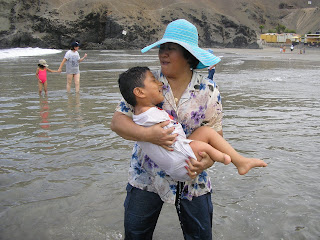
The other big event during my three weeks at Tony's was a trip to the beach. Tony has a North American friend named Bonnie who lives in Lima and runs an organization called Friends of Tony, which does a lot to support the house and the kids. The Monday before I left, they paid for a bus to come pick up all the kids from the house and drive two hours to a beach south of Lima, where one of Bonnie's friends has a nice house right on the shore. There were tons of (mostly white) adults there to supervise the kids for the day, equipped with blankets, umbrellas, sunscreen, and bag lunches for everyone. It was an amazing day! The shore has the same barren, windswept look that I remembered from last year; we were in a wide, shallow bay area between two extensions of sand-colored rock portruding out into the ocean. The waves crashed too far out to swim out beyond them, and the surf was less than rough but definitely fun. Within 10 minutes I'd left the kid I was supposedly watching playing in the sand with other little ones and their chaperones and jumped in with the teenagers.

Some of the kids come from the mountains or the jungle of Peru and had never seen the ocean before. Jefferson, a 4-year-old whose whole face is covered with burn scars from when he survived a fire as a baby, but who has more energy than any other 2 kids of the Hogar combined, kept asking me as we drove south along the shore with the sea clearly visible out the window--"Where? Where's the ocean? I don't see it." I guess he just didn't know what to look for.


At one point John and one of the 2 new American volunteers picked me up out of the comfortable beach chair I found and tossed me in the water like a sack of potatoes, which I suppose made up for the fact that I managed to escape being attacked during Carnavales this year. I definitely prefer being tossed in the ocean by friends to being attacked with water balloons by strangers on the street. These new American volunteers, Mark and Sam, arrived shortly after I did and fit in great at the house; they're both musicians, and besides playing and singing for the kids, we enjoyed staying up on Friday nights with guitars and a bottle of wine on the roof where the volunteers' rooms are.

The only thing to put a damper on our day at the beach was a kind of uncomfortable discovery for me: Bonnie's husband, whose work enables her to fundraise and organize so many wonderful events for the kids, is an engineer at a mining company. Mining, in the northern village of Tambogrande where the Peruvian SNDs all come from, is the Dark Side, the forces of evil, the industrial giant threatening to destroy the agricultural livelihood of the people. The people of Tambogrande and many other rural communities in Peru have spent years fighting to keep wealthy, international mining companies off their land, because when mining comes in, the land becomes useless for growing Tambogrande's famous mangos and limones, which is what the people there live off of. The mine provides work for a few peope for a few years, and then leaves when the gold is gone, and there's nothing for the people to do anymore. So it was a shock for me to look around at the beach and go, All this fun for the kids, all the donations this group has given to the house, all the good they've done... all of it comes from mining money.

And I watched all the wonderful, sweet, helpful, rich white people there playing with the kids, and thought, what can you do. Today these kids are having the time of their lives thanks to these people's generosity.

three beach beauties and Bryan
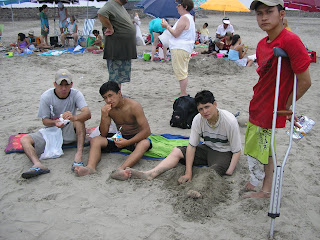
the guys looking chill
Mami Terri dunking a screaming Victor underwater to everyone's delight

And so my three weeks at the Hogar went by much too quickly. Even more than last year, I surprised myself by enjoying my time there so much. As a teenager I always hated babysitting, but I guess the dynamics of me and kids have changed a little now that I'm older. It's true that you can't spend 24 hours a day in the Hogar or you go crazy; but with frequent escapes to the Internet cafe or the coffee shop or just to take a nap, I always came back refreshed and not only ready but actually eager to spend more time with the kids. At one point, when we went to the farm where Tony gets his milk and the Argentinian owner of the place delights in entertaining the kids with horseback rides and snacks, I even thought to myself--Maybe I won't be miserable when I have kids!! What a surprising thought. As long as I didn't get stressed about keeping to the schedule (which no one should do in Peru anyway), it was really fun to watch them all swimming in the farm's pool, change the little ones into bathing suits, put my feet in and spray water on the kids, and jump in and get my pants soaked to the knee because Victor, who has no arms and only one leg, was sliding off the little ledge yelling for help before he went under.

I feel I should say more about the kids' disabilities and poverty and all that, but the fact is... you stop seeing that stuff after a while. Maybe another day I'll write about how my 25-year-old friend Marleney described her life in Cajamarca, living by herself in a little apartment outside of town, where she raises and kills and eats her own chickens and walks to town to carry water so as not to pay a bill for it and uses candles so as not to pay for electricity and supports herself knitting and washing. And all she wants is to get her operation so she can be back there living her own life, maybe with the guy who writes to her to say he's waiting for her, rather than being stuck in a house full of 60 kids in Lima. Or about Jaime, a 20-year-old who always wears a hoodie pulled up over his ears to hide burns on his neck, but is studying English in nearby Chosica in between his operations to remove the scar tissue. Or about a one-year-old named Raul with a double cleft palate who weighs what a three-month-old baby should weigh, because of malnutrition; or about the concerned mothers in the hospital who always want to talk to me about him, asking me if he's my kid, how he manages to eat with his mouth like that, some reprimanding me for being a bad mother and not putting socks on him (he had them on but one fell off and we lost it), others kindly helping me to change diapers during those crazy hours of waiting for the doctor. Or about the group of mothers I met in the hospital that were 15, 17, and 20 years old, all talking about what their babies had and what to do for them.

But at the end of the day, what I remember most about Chaclacayo is Mami Terri saying prayers with the kids in the great room at 8:00, and then helping to take the little ones upstairs to bed, and getting tons of hugs and kisses on the cheek and hearing "Buenas noches, Catalina!". And then heading down to the park for a few drinks with the volunteers, to relax, talk in English, and help each other figure out what on earth we're doing here.

Friday, February 22, 2008

Chaclacayo again

I don't believe how natural it feels now to live at Dr. Tony's in Chaclacayo. While last year I spent all my quiet moments here marvelling at the gray mountains, the flat-roofed houses, and the buses barrelling by on the highway, now this neighborhood feels like the Peruvian equivalent of my parents' neighborhood in Ellicott City. Quiet, beautiful, lots of green (comparatively speaking), and a VERY full house of kids to be with. Tony and Terri are still here, of course, the dad and the mom of the house respectively; the cooks, the teachers, the nurses, and about ten or so of the kids are still around from last year and doing exactly what they were doing back when I first got to Peru. Plus, my good friend John is back in Peru from Ireland, which is like having your big brother around again. So the Hogar even more than Lima feels like coming home.

There are about six or eight young kids who take up probably 50% of the volunteers' time. Two are in wheelchairs and three more can only walk with walkers, and they need help with tooth-brushing, going upstairs to the bathroom, putting on and taking off leg braces, opening the door to the patio, pulling other kids off them when they start fighting and end up squirming in a pile on the floor, etc. My favorite of these is Rocely, a nine-year-old mentally retarded girl who is in the house to receive therapy so she'll be able to walk. She gets this sneaky sort of grin when you look at her, and when I ask her, What?, she goes, What? back, and giggles, and I tickle her, and she laughs and laughs. My other favorite, who was around last year, is Mallco. His actual name is Juan Carlos Mallco, but last year there was a Juan Carlos Malchi, so they both went by their last names. Mallco came to the house last January as a tiny little five-year-old who scrambled around on the floor and jumped up on you like a puppy when he wanted attention--he has cerebral palsy, so he couldn't walk at all. He also didn't speak any Spanish, having come from a Quechua-speaking home in the mountains. His only way of communication at first, therefore, was to whine, and in a country where whining is an acceptable way for kids and adults to get what they want, this kid beat everything I have ever heard before or since. Now, however, he speaks great Spanish, has grown several inches and a little pot belly from eating the mamitas' abundant cooking twice a day, and is walking around the house with a walker and leg braces. He still whines, but not nearly as much.

Last Saturday my friends Sara and Celina from Lima came to visit and play with the kids, and at night we went out to Chosica to a karaoke bar. I had never been to a karaoke bar in my life and was expecting terrible suffering of the ears, but it was great! Those who couldn't really sing just did popular cumbia songs with their group of friends, and those who could hold a tune did so. My friend Ever kept ordering one jar of sangría after another, which may have accounted for my fearless renditions of Mariah Carey's Hero and Bette Middler's Wind Beneath My Wings.

During the week I usually have to go to Lima with the kids to their medical appointments, and the waiting is just as terrible as it was last year: there are no appointments beforehand, so you have to show up early, essentially take a number, and then wait for two to five hours for the kid to see the doctor. It's an utterly ridiculous system, there are huge crowds of people in the hospitals, and Tony's employees in charge of these trips usually have to push their way to the front of the line or get a friend who works there to give them special privileges ahead of the waiting crowds, in order to get the kids in. After one of these trips, which can last from six to eight hours there and back, I am utterly useless for the rest of the day and usually take a nap. It's amazing to me, given the extent to which the system doesn't work--the fact that the care the kids get is so often not what it could be--that Tony keeps running this whole operation day after day, dedicating his whole life to it, so that these kids can get even the insufficient medical care that's available. Because otherwise, they'd have no care at all. Dedicating your life to something that can never truly work as well as it should... is an act of faith.

But of course, don't get me wrong, there are many, many success stories from the house of kids who have gone home well to their families. And Tony says the doctors they see are good, it's just the logistics and resources that aren't there. And in the everyday reality of the house, you hardly think about the kids' treatment, you're thinking about the park and toothbrushes and finding Ronaldo's walker and getting out the guitars to play with the other volunteers... it sounds trite, but it's a whole house of people who are very far from their families and so become a family for each other.

And thanks to John, at least once a week we're down at the Chaclacayo park for drinks with the volunteers, for some badly needed relaxation after the kids go to bed.

Thursday, February 7, 2008

Back in the 'hood

I feel like I've been going between waking and dreaming for the past year or more--but I can't figure out which of my worlds is the dream and which one is real.

The change from Maryland to Lima is so fast and so complete that it really is like waking up and going to sleep. After a few hours of dozing on an airplane, EVERYTHING changes: the weather-- it's in the 80's and sunny in Lima right now; the landscape, dry and sandy with palm trees, brown hills covered in brown-orange brick houses one or two stories tall; the look of the people, short and black-haired and brown-eyed with skin anywhere from dark brown to light almond; the market, the buses, the ramshackle look of a city built up by its residents instead of by building companies. The noise: yesterday I knew I was in Peru again when I heard a guy driving slowly down the street shouting something unintelligible through a megaphone out the window, announcing something he's buying or selling. Very, very different. I was just getting used to my quiet suburban street in Howard County, with those incredibly tall and slender trees looking brittle in the winter; fresh cold air and bright sunlight at once; quiet, privately owned cars shusshing by on smooth paved roads with sidewalks and finished curbs; shopping at the mall, where it really didn't take long for me to swollow my aversion to American materialism and buy myself lots of new clothes; having a credit card and making good use of it to enjoy the marvellous comforts of America with my friends (if you have not been to The Melting Pot, go there, and then try to reconcile the utter heavenliness with the fact that you're spending more money on a meal than some people make in a month.)

And then beyond the environment, the mindset, at least mine, is worlds apart in the two cultures. In the US I found myself looking ahead to possibe Master's degrees and/or career paths and stressing out because, never having been the kind of person who knows what she wants to do with her life, I have many ideas but no set plan. There I feel an urgency to establish myself as something--which of course means to find a well-regarded job--to "get somewhere" at least mildly impressive, and then stay there. Very constricting. Here, in Peru, anything, and I mean anything, can happen (for example, the first indication I had that I was in Latin American culture again was on the plane, where a young woman comes on carrying this enormous, furry, floppy stuffed dog over her shoulder. Only in Peru do you see people hauling random, unweildy items half their own size onto public transportation and not expecting anyone to blink) and I can do anything I like that contributes to the school or the parish community. So despite the separation pains of leaving my home once again, it feels liberating to be here, ready to start some more adventures.

But what a difference between arriving last year and arriving this year! I got to Tupac at 1 in the morning and felt like, Oh good, somehow in all that traveling I wound up somewhere familiar... now I can crash for a while. It felt very surreal the first day, like I had gone back in time to visit friends from a long-gone era, and the next day I would wake up back in the real world again... My friend Sara came over for lunch with me and the sisters, and we went to the market to get a few things I needed, and in the evening there was Ash Wednesday mass, where I saw more of my friends and started to realize that maybe I was really in Peru. Last year feels very distant, like perhaps all that was a dream too, except that now I remember everything I see around here and I have friends hugging me and welcoming me back. And I'm even mentally prepared for Carnevales!

I have a lot of plans for this year that don't include English groups in the school. Heheh. I'm going to keep going with my singers from last year and start with another group of fourth graders; keep tutoring the most dedicated of Catherine's and my students from last year in English; keep singing in the church choir and the group that went to the competition (by the way, THANK YOU to everyone who bought CD's from me in the US! $7 per CD goes a long way here and we're planning to use the money to record an album all our own!); plus I'm going to look into being a catechist in the Confirmation program, maybe teach in the adult GED program IRFA like I always wanted to, except it moved at the beginning of last year and only just returned, and--my big idea of the year--I'd love to start a group of high school girls that would watch a movie together once in a while and use the movie to talk about girls'/women's issues, like respect, equality, careers, relationships, anything. Who knows. For now I'm just working on getting adjusted again; classes and all that will start up in March after I get back from Tony's, where I'm going on Monday.

My friend Adrian told me last night at church that it was like I'd never left, but I said, nooo, it's very different. Last year I had left my home for a strange world and hadn't been back since; now, I've been here, I've been there, I know I'll be back there again, but I also know my way around Lima and can relax a little and enjoy this world for another year before going back to that other life. My great dilemma will be finding something I can do in the States that will give me the same sense of community and purpose that I have here--the sense of just surrendering your life to the crazy forces of Life in general and giving whatever you have to offer to the people you find yourself near. Somehow, without really meaning to, I've become something between a Peace Corps worker and a nun.

Cool.

Saturday, January 12, 2008

Help support my work with NDMV for 2008!

On February 5th, I will head back to Peru to serve as a Notre Dame Mission Volunteer in Lima for the year 2008.

I have learned a lot this past year about the kind of work that is feasible for me and valuable for the community I serve. At NDMV's missioning service for the 2008 international volunteers, I spoke a little about my experience trying to make a difference in Lima and how the true value of my service goes beyond my actual projects to include the simple fact of my presence to the people there, and their presence to me. Sometimes the most profound effects of one's presence at a service site are interpersonal and invisible--for example, friendships that let two different cultures come together and lead to changes in perspective on both sides. And yet above and beyond these connections, I have also had the privilege of making a small difference in the neighborhood of Tupac Amaru by teaching English, teaching music, directing my fourth grade chorus at Fe y Alegria, and serving in the parish of Jesus Artesano.

Although progress is often slow on my projects and the difference they make seems small, I reassured everyone present at the missioning service that beyond a doubt, my work in Peru is worth it. Its effects extend even beyond the community where I serve, because living in Lima has drastically altered my perspective on the world and encouraged me to share what I've seen and learned with those who are close to me in the United States.

As a nonprofit organization, Notre Dame Mission Volunteers relies on donations to support its volunteers abroad. If you are interested in helping to support my work in Peru for 2008, I invite you to make a donation to Notre Dame Mission Volunteers. Checks can be made out to Notre Dame Mission Volunteers, with "Kathleen Fritz--Peru" in the memo line, and mailed to:

Notre Dame Mission Volunteers
403 Markland Avenue
Baltimore, MD 21212

Or, you can donate online at www.ndmva.org (follow the link to "donate" and indicate "Kathleen Fritz--Peru" as the purpose of your donation.)

Any amount that you feel comfortable donating will make a difference. Even a small amount of money by American standards can go a long way in Peru! The donations received by NDMV will be used to support me during the year so that I can dedicate my time to my classes and to the parish community.


On a musical note, I'd also like to invite you to support a group of young Peruvians from my parish who are beginning to establish a musical career as performers and composers. This group of young people, called Voces Juveniles or "young voices," has no formal musical training or music education in their backgrounds, but they have learned from one another and from other musicians. In the past two years they have come together to form a group of singers and instrumentalists that performs both traditional Peruvian folk music and their own arrangements of popular music.

This year the group entered an original song in a competiton with the theme of justice and peace, and the song was selected as one of six finalists to perform at a daylong youth workshop on that theme. You can view a video of the group performing their song at:

http://www.youtube.com/watch?v=bovg_SBCu90

Guess who the tall blonde one singing on the left is! :) Besides being up-and-coming musicians, these people are my friends from the parish. They have been incredibly supportive and welcoming to me and it has been an honor to be involved in their music-making. More than anything, I am constantly impressed by how much they can produce from virtually nothing--aging instruments, no training, a cold rehearsal space with other young people doing less wholesome activities on the sidewalk outside, etc. They even have to combat their own tendency to be chronically late to rehearsals and engagements, which in my mind is one of their biggest obstacles to success--but somehow they manage to progress anyway!

Just for being selected as finalists, we got to record our song professionally on a CD with the other finalists. It was a really exciting opportunity, and the experience gave these young musicians a taste for a more professional level of performing and recording! Our goal for this coming year is to record an entire CD of our own original songs. To help us toward that goal (studio time is expensive even in Peru!), we are selling the CD of the six songs selected as finalists in the competition. Song #4 is ours, the only one in traditional Andean style with panpipes and a quena flute, but the other tracks are also original compositions by young Peruvian musicians and several of them are quite good.

The cost of the CD is 21 soles, or 7 US dollars, and it comes complete with a translation of all the songs into English by yours truly. If you're interested in supporting this group by purchasing a CD, you can contact me at:

email: ksfritz@gmail.com
phone: 410-750-6324

Many thanks for all the support you have given me over the past year and for your continuing generosity! The Sisters of Notre Dame and I will be praying for you and wishing you all the best in this new year.

Merry Christmas and Happy New Year

I'm home!
Aaaaaaaaaaaaaaaaaaaaaaaaahhhhhhhhhhhhhhhhh.

....

Christmas was very interesting in Peru. It didn't really feel like Christmas, for one thing because it was 70 degrees and sunny. There are no real Christmas trees to speak of in Lima, but there are lots of tiny plastic mini-trees hung with a few token ornaments next to the nativity scene, which is the main focus of Christmas decorating. Nativity scenes can be very elaborate and beautiful, with the people formed like indigenous Peruvians and dressed in traditional Peruvian clothes. Ours also had lots of fanciful, rainbow-colored animals from parrots to fish surrounding the baby Jesus.

We went to church at 9 pm on Christmas Eve and afterwards everyone went home to their families for dinner. A typical Christmas dinner is turkey with noodles, accompanied with salads, eaten between 11:00 pm and 12:30 am on the 24th-25th. My friend Selina came to have dinner with me and the nuns (since Catherine was already gone! I had to survive a week in Peru without my Caty. I did pretty well--I went shopping a lot with Selina and Sara.) At midnight exactly, the firecrackers started. The nuns wouldn't let me go outside because these are not nice, legal, organized fireworks like 4th of July, they're backyard firecrackers being set off by everybody and their kid brother, and apparently there are some, nicknamed White Rats, that shoot around in random directions before they explode. So I just peeked out the door at the whole exploding chaos. It sounded like the whole area was being bombed, but the people were walking around happily on the streets. Our electricity went out, probably because a firecracker hit a cable, and everybody was bummed because there was no way to play music and dance. So we cleaned up dinner waiting for the bombardment to subside, and at 12:30 we headed to the other house, where the electricity was still on. And in traditional Peruvian style, Iris, Consuelo, and I stayed up dancing until 3:30 in the morning.

Christmas Day didn't feel like Christmas Day either because the celebrating was all over by morning. I went over to spend the day with my friends Sara and Willy, and in the evening we played volleyball with my friends from the parish. They string a net across the street in front of the church and hold it up every time a mototaxi wants to go underneath. A couple of my friends took me out for chicha and pizza afterwards, a little mini-goodbye party, which was very sweet. And the next day I moved out of my room. I spent all day packing and cleaning, Sara and Willy helped me bring what I wasn't taking to the US down to the house in Tupac where I will live this coming year, and in the evening I was ready to go. I went to the regular Wednesday evening Mass and played guitar with Alfredo, practically jumping up and down and hugging everybody who came near me; Mass ended, and I got escorted back up to my house by a crowd of friends, saying goodbye in real Peruvian style by "accompanying" me until the last minute; and the taxi came for me at 9 pm, and I piled in with Iris, Consuelo, Robert, and Juancho as my escort to the airport.

I remembered the night I first got in to Lima and drove along the highway by the beach, staring at the cliffs and the palm trees and the unfamiliar flat-roofed buildings. It seemed unreal that I was actually going home. But I was giddy anyway.

The travel was long but uneventful. I delightedly drank the ice Delta Airlines gave me in my juice. In Atlanta there was a train inside the airport, with a smooth automated voice announcing "Next stop: Concourse B," with people standing quietly inside and moving when the automatic doors slid open instead of yelling BAJA! to get off. There was CNN and the Iraq war and football on the airport TVs, American accents, toilet paper in the bathrooms!, wide, clean spaces with carpet or tile floors, people who looked weirdly tall and pale, complicated computerized display boards of flights and times and locations. Sleepy, disgruntled, slightly overweight customs officials, very different from the smartly attentive señoritas in Peru. People slightly surprised at being asked if they had change for a dollar. I felt boldly friendly for acting the way people normally act in Peru, interacting with strangers in public, asking for help before even reading the signs.

It was weird to hear informal American English from the captain and the flight attendants--"Folks, if you'll bear with us just a few minutes, we should be on the road shortly." "Can I get you something to drink?"--and to prepare my responses in English, not Spanish, and realize almost with surprise that I knew all the typical phrases to do so. "Excuse me, could I get a...?" "Hi, do you have...?" "Thanks, have a good day!" Flying into Dulles over northern Virginia, I was mesmerized by the trees and grass and the little, isolated white houses tucked in among them on their private lots. They looked ridiculously extravagant. In Lima the houses are all built like rowhomes. I realized I was really home because the buildings outside the window all looked like the kind of places they were, instead of rectangular, flat-roofed brick things that could be houses or offices or stores or restaurants. And the cars--there were huge parking lots full of shiny little cars that glittered in the sun, sparkly new instead of junkyard-worthy! Glittering cars and McMansions tucked away in the woods. My home!

My mom and siblings met me at the airport and Jamie freaked me out by having a beard. I wanted to play combi in the parking lot (full of private cars! No buses!!) but my sisters looked at me weird when I demonstrated hanging out the window yelling our destination and whacking the side of the car to pull over and let somebody on. It was sunny and 50 degrees and I said, it's COLD! and had to put on my sweater. Most beautiful was the light--that distinctive, golden light of a northern-hemisphere winter, slanting on trees and grass and highways with green median strips.

At home I started taking pictures of things like the Christmas tree and our family room. The sheer amount of space in my house is pretty scandalous, especially since the whole thing is being heated or cooled most of the year. And it is so quiet! The roads are quiet because everyone stays in their own cars, it's too cold to have the windows all down and the music blaring and the cobradores shouting. The streets are quiet because there's no mototaxis or buses or stray dogs wandering around or women trudging around honking bicycle horns to announce they're selling bread. (not to mention NO WHISTLES ON THE STREET! Although I did get a "How you doing today?" on the College Park campus when I went down to visit professors, so... yeah. At least on my street I can walk around utterly unnoticed!!!) The first night I was home, I put on my Peruvian music and taught everyone to dance, and later my brother made enchiladas (unheard of in Peru) with frozen packaged chicken, listening to Jason Mraz and using the dishwasher and microwave while Annie's clothes dried in the dryer upstairs. Everything was so weird and yet I can go on auto-pilot and navigate it all in my sleep, it's so natural it's automatic. And to be in a world that works exactly like you have learned it does your whole life is very, very deeply relaxing.

We had a great Christmas party with tons of family and more dancing in the kitchen. My little cousins have grown up a lot since I last saw them and I've met three new babies in the family that were born last year. I spent New Year's with my college friends and gave them all chullos.

I'm spending my time hanging out with high school and college friends and visiting my relatives. Occasionally I try to practice yoga with a DVD I got for Christmas. Friends, baby cousins, favorite restaurants, Daddy hugs, real pizza, big soft sofas to lounge on and big fluffy pillows, trees and grass and sunny cold weather... aah, America the beautiful.